Быстрый ответ
Choose металлические банкетные стулья by how your venue handles them. Aluminum is the lightest and most rust-resistant, which suits venues that set up and break down constantly and humid or outdoor spaces, but it costs the most. Steel is the best all-round value: strong, mid-weight and mid-priced, with rust held off by a powder-coat finish. Iron is the strongest and cheapest but the heaviest, which suits budget projects where chairs stay relatively put. Match the metal to your handling and budget, and pair it with a comfortable contract-grade seat.
The choice between aluminum or iron banquet chairs — and steel, the third metal most buyers overlook — decides the weight your staff lift at every event, the price you pay per chair in bulk, and how long the frames last under constant handling. The three look almost identical in a photograph, yet they behave so differently that picking the wrong one costs a venue in labour, replacements or both. To see the frames this guide compares, browse our banquet furniture collection; below, we set the three metals side by side and recommend the right one for each kind of venue.
This guide compares aluminum, steel and iron banquet chairs on the things that matter — weight, strength, cost, rust resistance and stacking — then works through each metal in turn, covers the finish and upholstery that sit on top of any frame, and ends with a clear recommendation by venue type and some buying guidance. Every point assumes a working venue that handles its chairs hard, not a dining room where they stay put.
Why the Metal Frame Decides Everything
The frame is the chair. The seat covering changes the look and the comfort, but the metal underneath sets the weight your team lifts, the strength that carries guests safely, the resistance to rust in a damp room, and the price you pay across hundreds of chairs. Get the frame right and a chair serves for a decade of events; get it wrong and you pay for the mistake at every setup or every replacement.
Weight, strength, cost and rust in one decision
Four properties flow from the metal, and they trade against each other. Weight decides how fast and how safely staff handle the chairs; strength decides how much abuse the frame takes; cost decides what a bulk order runs to; and rust resistance decides how the chairs survive humidity or an outdoor event. No single metal wins on all four, so choosing well means knowing which property your venue values most.
Metal is the umbrella; aluminum, steel and iron are the choices
Most buyers search for metal banquet chairs as a single category, but metal covers three distinct frames with very different characters. Aluminum is the lightweight, rust-proof option; steel is the strong, balanced all-rounder; iron is the heavy, sturdy, low-cost classic. Treating them as one product leads to the wrong buy, so this guide separates them — because the right answer to which metal you need depends entirely on how the chairs will live.
Weight is a labour cost, not just a number
Buyers compare frame metals on price and strength and forget that every kilogram a chair carries gets lifted hundreds of times a season. A heavier iron chair saves money on the quote and spends it on staff hours and tired backs at every setup. Price the weight as labour across a year of events, and a lighter aluminum frame often closes the gap the sticker price opened.
Aluminum vs Iron vs Steel Banquet Chairs at a Glance
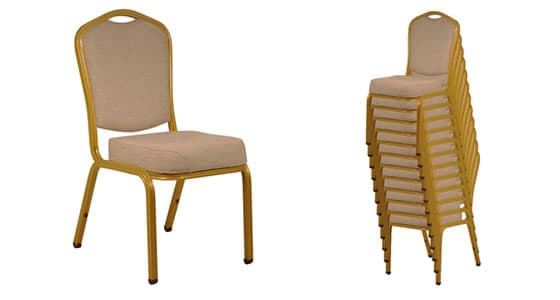
Before the detail, it helps to see the three metals side by side. The infographic and table below compare aluminum, steel and iron banquet chairs on the properties that decide the buy, so you can spot the right direction before reading the deeper sections.
| Недвижимость | Aluminum | Steel | Iron |
|---|---|---|---|
| Weight | Light | Средний | Heavy |
| Strength | Good | Very high | Highest |
| Cost | High | Mid | Low |
| Rust resistance | Excellent | Good (coated) | Needs coating |
| Stacking & handling | Easiest | Easy | Hardest |
| Лучше всего для | Frequent setup; humid/outdoor | All-round value; high volume | Budget; chairs stay put |
Why steel belongs in an aluminum-or-iron decision
Most buyers frame the choice as aluminum versus iron and miss the metal that often beats both: steel. Steel splits the difference, carrying nearly iron’s strength at less weight and well under aluminum’s price, which makes it the quiet winner for a large share of indoor venues. Leaving steel out of the comparison forces a venue to choose between a light, costly frame and a heavy, cheap one, when the balanced middle option fits its needs better. Comparing all three is what surfaces the right answer.
How to read the comparison
The pattern is consistent: aluminum wins on weight and rust, iron wins on raw strength and price, and steel sits in the middle as the balanced choice. None is simply best — each leads on the properties that suit a particular venue. Read the comparison as a map to your priorities, then let the deeper sections confirm the direction for your specific events and budget.
Aluminum Banquet Chairs
Aluminum is the lightweight specialist of metal banquet chairs, and it earns its premium in venues that move furniture constantly. Where setup speed and rust resistance matter most, aluminum is hard to beat.
The advantages of aluminum frames
Aluminum brings two standout strengths: it weighs far less than steel or iron, and it does not rust. The light weight speeds every setup and teardown and spares staff backs across a long season, while the natural rust resistance makes aluminum the safe choice for humid ballrooms, poolside events and outdoor functions. Aluminum chairs also stack and lift the most easily of the three, which compounds the labour saving.
The trade-offs of aluminum
Aluminum costs more per chair than steel or iron, so a large order carries a higher upfront price. It is also softer than steel, so a careless knock dents rather than bounces, though a quality contract frame resists everyday handling well. For venues that move chairs constantly, the weight and rust advantages usually outweigh the price; for those where chairs stay put, the premium is harder to justify. You can see our lightweight range on the аллюминиевые банкетные стулья страница.
Where aluminum fits best
Aluminum suits the venues that handle chairs hardest. Wedding venues and caterers that set up and break down weekly, hotels with humid ballrooms, and anywhere with outdoor or poolside events all benefit from the light weight and the rust resistance. If your team lifts chairs constantly or your events meet the weather, aluminum repays its higher price in saved labour and longer life.
Steel Banquet Chairs
Steel is the balanced all-rounder and, for many venues, the smartest buy. It pairs most of iron’s strength with less weight and a mid-range price, which is why so many halls standardise on it.
The advantages of steel frames
Steel delivers very high strength at a sensible weight and price. A tubular steel frame takes heavy, repeated handling without flexing, weighs less than iron so staff move it more easily, and costs less than aluminum, which keeps a bulk order affordable. With a good powder-coat finish, steel also resists rust well in most indoor settings, giving a venue strength and value in one frame.
The trade-offs of steel
Steel weighs more than aluminum, so it tires staff faster across a long setup and needs a sturdy trolley to move in volume. It also relies on its coating for rust resistance, so a chip in the finish can let corrosion start in a damp room — which makes the quality of the powder coat important. For most indoor, high-volume venues, none of this outweighs the strength-and-value balance steel offers.
Where steel fits best
Steel suits high-volume halls and venues that want the best all-round value. A hotel banquet department, a conference centre or a busy events hall that needs hundreds of strong, affordable chairs and stores them indoors is the natural home for steel. When you want most of iron’s strength without its weight, and you do not need aluminum’s rust resistance, steel is the balanced choice.
Iron Banquet Chairs
Iron is the heavy, sturdy classic of metal banquet seating, and it wins on two things: raw strength and the lowest price. Where budget leads and chairs stay relatively put, iron still earns its place.
The advantages of iron frames
Iron offers the most strength for the least money. A solid iron frame takes the heaviest, most careless handling and carries weight without flexing, and it costs less per chair than steel or aluminum, which makes a large order the most affordable of the three. For a venue buying in volume on a tight budget, iron stretches the furniture spend furthest.
The trade-offs of iron
Iron is heavy, which is its real cost. The weight tires staff at every setup, demands sturdier trolleys, and slows a room turnaround — a labour price paid event after event. Iron also relies on a finish for rust resistance, so it needs a good coating and care in damp or outdoor settings. Where chairs move constantly, the weight erodes the price advantage; where they stay put, iron’s strength and low cost shine.
Where iron fits best
Iron suits budget-led projects and rooms where chairs stay relatively in place. A venue furnishing a large hall on a tight budget, or one where chairs sit in a fixed setup rather than moving daily, gets the most from iron’s strength and low price. Where the saving on the quote is the priority and the handling is light, iron remains a sound, sturdy choice.
Finish, Rust Resistance and Upholstery
Two things sit on top of any metal frame and matter as much as the metal itself: the finish that protects it and the seat that meets the guest. Get these right and any of the three metals performs; get them wrong and even the best frame disappoints.
Powder-coat finishes and rust resistance
The finish is what keeps steel and iron from rusting, so treat it as part of the specification. A quality powder-coat finish seals the frame against moisture, resists chips and scratches, and comes in the colours a venue wants. Aluminum needs less protection because it resists rust naturally, but a powder coat still gives it colour and a durable surface. For damp ballrooms and outdoor events, the finish quality matters as much as the metal beneath it, so ask how the frames are coated.
Comfort, foam and weight capacity
Whatever the frame, the seat decides comfort and safety. A dense, high-resilience foam keeps guests comfortable through a long dinner or conference, and a tested weight capacity keeps guests of every size safe within the frame’s rated limit. Ask the maker for the weight capacity as well as the chair weight, and choose a frame rated comfortably above your everyday needs. Comfort does not depend on the metal, so none of the three frames forces a hard seat.
Upholstery that lasts and cleans
The covering faces the guest and the cleaning cloth at once, so it has to look right and wipe down fast on any metal frame. A contract-grade, abrasion-rated fabric handles spills and cleaning between events and meets the fire-safety standard your market requires. Our guide to banquet chair upholstery covers the fabrics and foams that last, and they pair with any of the three frames.
On steel and iron, the finish is the rust defence — not the metal
Venues compare frame metals and forget that a steel or iron chair only resists rust as well as its coating. A cheap finish that chips lets corrosion start in a damp store within a season, while a quality powder coat keeps the same frame sound for years. When you buy steel or iron, specify the finish as carefully as the metal — it is what actually holds the rust off.
Choosing the Right Metal Banquet Chair for Your Venue
The right metal follows from how your venue runs, so let the handling and the budget point the way. A few clear cases cover most venues.
If you set up and break down constantly
Choose aluminum. A venue that resets rooms daily, a caterer that loads vans every week, or a hall with humid or outdoor events gains most from aluminum’s light weight and rust resistance. The labour saved at every setup, and the chairs that shrug off moisture, repay the higher price across a busy calendar.
If you want the best all-round value
Choose steel. A high-volume hotel or conference venue that stores chairs indoors and wants strength without aluminum’s price is the natural home for steel. It carries the load, weighs less than iron, and keeps a bulk order affordable, which makes it the default for most indoor banquet operations.
If budget leads and chairs stay put
Choose iron. A project furnishing a large room on a tight budget, where chairs sit in a relatively fixed setup, gets the most from iron’s strength and low price. As long as the handling is light and the finish is good, iron stretches the spend furthest. For the wider buying picture, our pillar on how to choose banquet furniture sets the metal choice in context.
Buying Metal Banquet Chairs
Venues buy banquet chairs in the hundreds, so the order is a project. Whichever metal you choose, a contract manufacturer brings the build quality, the volume and the support a one-off purchase cannot.
Bulk orders and customisation
Volume is where a manufacturer earns its place. Ordering a large quantity of matching chairs at a wholesale price keeps the room consistent and the cost per chair down, and it lets a venue specify the metal, the powder-coat colour and the upholstery to suit the space. Plan the quantity around your largest room plus a margin for growth, so the inventory covers your biggest booking with chairs to spare.
Choosing a supplier and what to ask
The supplier decides whether the frames you specified arrive as promised. Ask which metal and gauge they use, how the frames are welded and finished, the tested weight capacity and stack height, and what the lead time and warranty cover. A maker that explains the construction clearly and stands behind it with a warranty is the one to trust. Our guide to choosing a banquet furniture supplier sets out the full checklist.
Matching chairs to tables and the inventory
Chairs rarely arrive alone, so buy them alongside the tables and trolleys from one supplier to keep the inventory matching and the reordering simple. Match the seat height to your tables and the finish across the set, so the room reads as one design. Our banquet tables are sized to pair with metal banquet chairs, and to start a project, our сеть столовых мебели is the place to begin.
Whichever metal you choose, judge the chair by the life it leads, not the price on the quote. Weigh the weight against your labour, the finish against your humidity, and the strength against your handling — and the frame that fits your venue, with the right finish and a comfortable seat on top, will pay it back at every event for years to come.
Часто задаваемые вопросы
Should I buy aluminum or iron banquet chairs?
Choose aluminum if your venue sets up and breaks down constantly or hosts humid and outdoor events — it is lighter and rust-resistant, though it costs more. Choose iron if budget leads and chairs stay relatively put — it is the strongest and cheapest but the heaviest. For most indoor, high-volume venues, steel sits between the two as the best all-round value.
What is the difference between aluminum and steel banquet chairs?
Aluminum is lighter and naturally rust-resistant, which speeds handling and suits humid or outdoor venues, but it costs more and dents more easily. Steel is stronger and cheaper, carries heavy handling well, and resists rust through its powder-coat finish, but it weighs more. Venues that move chairs constantly favour aluminum; high-volume indoor halls usually favour steel.
Are iron banquet chairs better than steel?
Iron offers the highest strength and the lowest price, but it is heavier than steel, which makes it harder to handle and slower to set up. Steel gives most of iron’s strength at less weight and a mid-range price. Iron suits budget projects where chairs stay put; steel suits venues that need strong chairs they also move regularly.
Do metal banquet chairs rust?
Aluminum does not rust, which is one of its main advantages. Steel and iron can rust if their finish is damaged, so they rely on a quality powder-coat coating to keep moisture out. In damp ballrooms or outdoor settings, choose aluminum or insist on a high-quality finish on steel or iron, and repair any chips promptly.
What is the weight capacity of a metal banquet chair?
Contract-grade metal banquet chairs are tested to a rated weight capacity that comfortably holds guests of every size, and the exact figure varies by frame and gauge. Iron and steel frames typically carry the highest ratings, with aluminum close behind. Always ask the maker for the tested weight capacity rather than assuming, and choose a frame rated above your everyday needs.
How do you clean and maintain metal banquet chairs?
Wipe the frames and seats with the products the maker approves, clear spills before they set, and inspect the powder-coat finish for chips so rust never starts on steel or iron. Tighten any joints that loosen and check the stacking bumpers and glides on a schedule. A contract-grade fabric handles regular cleaning, and a sound finish keeps a metal frame looking new for years.
Are metal banquet chairs comfortable for long events?
Yes — comfort comes from the seat, not the metal, so any of the three frames can carry a comfortable chair. A contoured seat, a supportive back and a dense, high-resilience foam keep guests comfortable through a long dinner or conference. Sit-test a sample before a bulk order to confirm the seat suits long events, whichever frame you choose.