Definition
Budget hotel room design is the practice of planning a 3 or 4 star guest room so it feels comfortable, durable and coherent without overspending — concentrating the budget on the few things guests touch and notice, and saving on everything they do not.
Strong budget hotel room design proves a simple point: guests rebook a room that feels considered, not the room that cost the most to build. In a 3-star or 4-star hotel, a tight budget decides almost nothing about whether the room works — the decisions do. The furniture carries most of that weight, so your choice of Meubles d'hôtel shapes the budget, the timeline and the review score at once.
This guide covers where smart money goes, where it holds back, and how budget hotel room design turns a plain 3 or 4 star room into one guests remember. Every recommendation assumes a contract setting, not a home renovation — durable specs, repeatable across 40 or 400 rooms, built to survive daily turnover. The aim is simple budget hotel room design that reads a tier above what it cost.
What Makes a Good Budget Hotel Room Design
A good budget hotel room design starts from one rule: guests never notice an even spread of money, but they always notice the two or three things they touch and the one thing that fails. So you concentrate the budget where the guest’s hand and eye land, and you hold back everywhere else. Three levers do most of this work, and none of them is expensive — they reward planning, not spending. Get them right and the room photographs well, holds up under daily turnover and keeps guests from noticing what you saved on; get them wrong and no furniture spend rescues the first impression. That gap, between a room that reads cheap and one that reads considered, is the whole job of budget hotel room design.
Spend Where Guests Look, Save Where They Don’t
Put the money on the mattress, the bedside light, the bathroom fittings and a strong headboard. Pull it back on flooring, case-good finishes and wall art, where a cheaper choice reads the same to a guest. Durable MDF-Lam case goods in a clean finish carry a 3-star room without straining the budget, and vinyl or laminate flooring looks the part at a fraction of the cost of timber. This is the core of budget hotel room design: not spending less everywhere, but spending on the right few things.
Think in terms of contact. A guest lies on the mattress for hours, grips the bedside switch in the dark, stands at the bathroom basin and leans on the headboard — those surfaces earn the spend. Nobody measures the wardrobe’s edge banding or the exact shade of the skirting, so those lines absorb the savings. Work this way and a 3-star budget stretches to cover the pieces that decide a review. The best budget hotel room design ideas all come back to this single trade.
A Palette That Hides the Budget
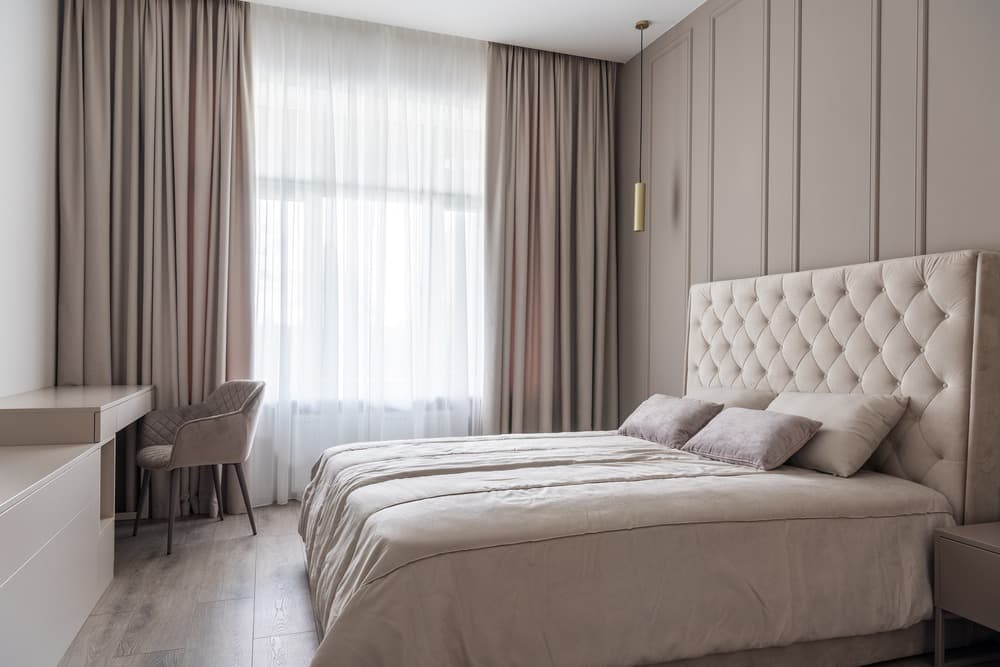
Colour does the first job in any room, and it costs almost nothing. Pick a neutral base — warm white, soft greige, muted stone — then match the floor and ceiling to it. Pull one accent colour from your brand and repeat it in a headboard panel, a bed runner or the lampshades. Hold the whole room to three colours: a base, a secondary and a single accent. A disciplined palette is the cheapest move in budget hotel room design, because paint and textiles cost little yet set the tone the furniture only completes. Keep the same logic across every room type, so a guest who books twice recognises the property the second time.
Neutral does not mean dull. Layer two or three textures in the same family — a woven runner, a matte headboard, a soft drape — and the room gains depth without one expensive object. A flexible base also makes refresh cycles cheaper, since a hotel re-dresses a bed far more often than it repaints; new textiles update the look for a fraction of a full redecoration.
Lighting Does the Heavy Lifting
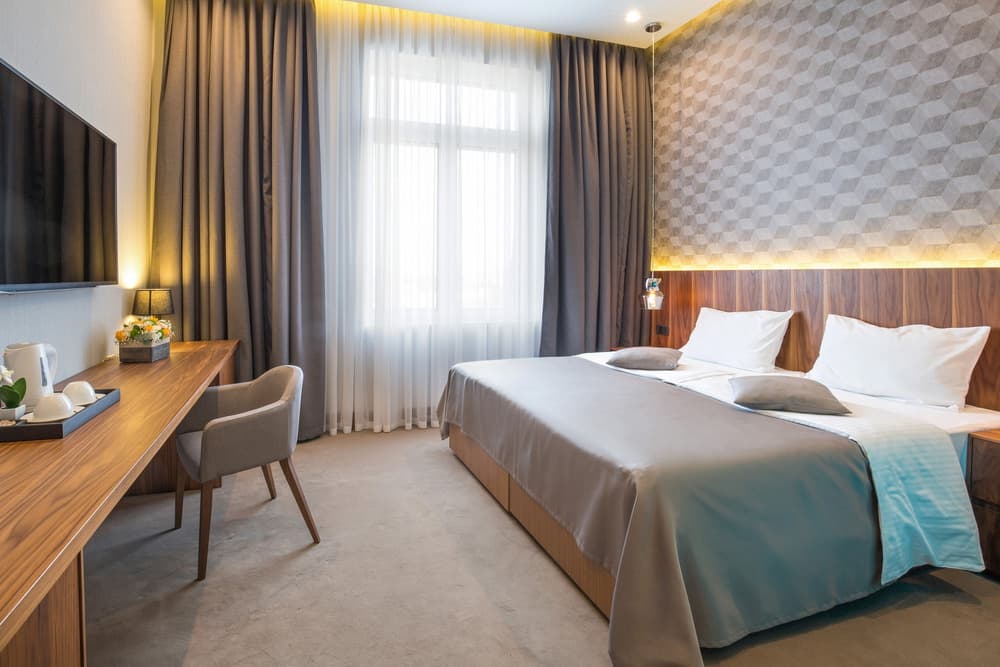
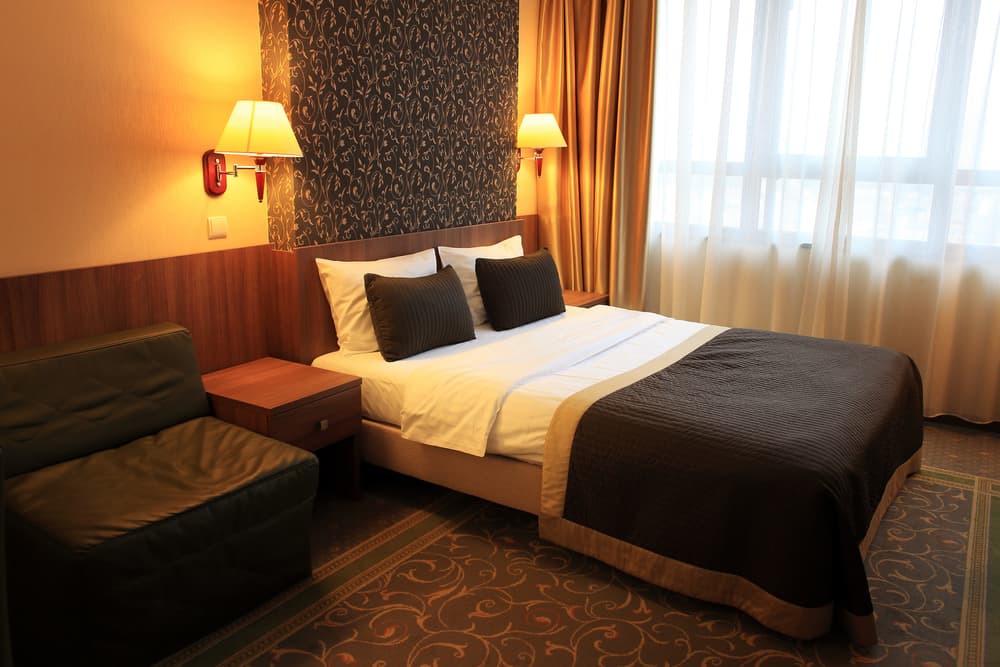
Lighting turns a finished room from flat to inviting, and it forgives a tight furniture budget better than any other element. Build it in three layers: a soft overhead, a bedside source each guest controls without leaving the pillow, and one task light at the desk or mirror. Stay warm at 2700K to 3000K, the range that reads as rest rather than office, and put the bedside and overhead on separate switches. Skip cold white near the bed — it drains every warm tone in the palette and makes linen look grey in photos. Dimmable bedside lamps cost little and signal a tier above the room’s actual budget. One rule keeps the spend honest here: buy fewer, better fittings. A single well-placed bedside lamp does more for comfort than a ceiling fixture twice its price, and a dimmer costs less than the goodwill it earns. Lighting is the one upgrade in budget hotel room design that scales across every room without scaling the cost.
A tight budget is not the enemy of a good room. A budget spread evenly is.
Light decides the first eight seconds
Guests judge a room before they touch the furniture, and light drives that judgment more than anything else. A space shot under warm, layered lighting reads a full star-tier above the same room under a single cold ceiling bulb — and the lamps cost a fraction of the bed. No line in budget hotel room design returns more for less.
Budget Room Design by Star Tier: 3-Star vs 4-Star
The same principles apply at both tiers; only the spend on finishes changes. A 3-star room prioritises durable, functional furniture and essential comfort. A 4-star room keeps that discipline and adds affordable-luxury touches on top. The table below sorts the common elements into spend and save for each tier, so you can build budget hotel room design ideas around where the money actually shows up. Read the two tiers as one recipe at two budgets: nothing in the 4-star column is exotic, it is the 3-star room with the spend nudged up on the items guests grade hardest.
Réponse rapide
What should a budget hotel room never cut? The mattress, the bedside light and the bathroom fittings. Guests sleep on the first, reach for the second in the dark, and inspect the third within a minute of arrival. Save on flooring, case-good finishes and wall art instead — none of those decide a review.
| Room element | 3-Star approach | 4-Star approach | Call |
|---|---|---|---|
| Mattress & bedding | Quality mattress, mid-range linen | Premium mattress, high-thread linen | Spend |
| Bedside lighting | Single dimmable lamp | Dimmable lamp plus reading light | Spend |
| Bathroom fittings | Modern faucet, good towels | Rainfall shower, stone or quartz top | Spend |
| Tête de lit | Upholstered panel | Statement headboard | Spend |
| Case goods | MDF-Lam, durable finish | Veneer fronts, custom sizing | Save |
| Flooring | Vinyl or laminate | Premium large-format laminate | Save |
| Wall art | Framed prints | Curated prints, larger scale | Save |
| Visible cabling | Tidy and hidden | Integrated cable management | Skip |
3-Star Rooms: Function First
A cost-effective 3-star room runs roughly 150 to 250 square feet and earns its rating on durability and function, not decoration. Choose modular or multi-functional furniture to save space, standard-size beds for easy replacement, and hard-wearing surfaces that survive housekeeping. A simple hotel room design at this tier still feels welcoming when the palette is tight and the lighting is warm. Wall-mounted desks and built-in wardrobes keep the floor open and the furniture count low — the kind of move that defines smart budget hotel room design.
Keep the piece count low and the finishes consistent. A bed and headboard, two nightstands, a wall-hung desk, a slim wardrobe and a luggage bench furnish a complete 3-star room; anything beyond that crowds both the floor and the budget. Match every finish to one timber tone and one neutral, and the room reads as a designed set rather than a pile of separate buys.
4-Star Rooms: Affordable Polish
A 4-star room does not need a bigger budget on every line — it needs the budget placed higher up. Invest in premium-looking bedding, a statement headboard and better bathroom fittings, and use decorative mirrors to make the room read larger. Cost-effective stone or quartz countertops stand in for marble, and high-quality towels do more for the impression than an expensive television. This is where hotel interior design on a low budget earns its keep: a handful of upgrades, placed where guests notice, lift the whole room without lifting the whole cost.
The trick is restraint. Two or three deliberate upgrades land harder than ten small ones, because guests register the statement headboard and the rainfall shower and quietly forgive the laminate floor. Spend on what they photograph and mention, and let the rest stay simple. Done well, hotel interior design on a low budget at this tier is hard to tell from a room that cost far more. The budget did not shrink the experience; it simply went where guests could see it.
Budget Comfort Details Guests Notice
Comfort is the quiet half of budget hotel room design, the part no floor plan shows. It lives in small, cheap details that a guest cannot name but feels, and together they lift a plain room into one that earns a warm review. For the broader question of how to make a room feel personal and inviting, our guide to creating a cozy and comfortable hotel room goes deeper; the budget essentials are below.
A Reading Nook Guests Notice
Give the guest somewhere to sit that is not the bed. A single armchair in the corner with a slim side table and a reading light turns a sleeping box into a room. The piece does not need to be expensive — it needs to be comfortable and to survive a few thousand guests. A compact upholstered chair with a wipeable frame does the job in a 3-star room, and a fuller lounge chair suits a 4-star corner. You bought a chair and got marketing, because guests photograph corners like this.
Scent and Air
Scent reaches a guest before sight does, and a stale room loses the review in the doorway. Clean the air first, then add a light, consistent scent through a low-output diffuser or a neutral reed. Keep it subtle — a heavy fragrance reads as a cover-up. Fresh flowers in a suite, a single diffuser in a standard room and a strict no-smoke policy do more for perceived cleanliness than any upgrade to the furniture.
Low-Cost Storage
Guests settle when they can put their things away, so give them enough storage that a suitcase never lives on the floor. Hanging rails cost little and read cleaner than a bulky wardrobe in a small room. Add a luggage bench at the foot of the bed, a few real hangers rather than theft-proof stubs, and a nightstand drawer for small items. Storage is the least glamorous line in budget hotel room design and the one guests miss most when it falls short. Under-bed clearance for a second bag finishes the job. None of these moves shows on the budget line, yet together they decide whether a room feels like a place to stay or only a place to sleep — exactly the margin good budget hotel room design works in.
An unpacked guest stops noticing clutter
A guest who unpacks stays longer in spirit. Rooms with real, visible storage score higher on cleanliness and comfort in guest surveys — not because they are cleaner, but because an unpacked guest stops noticing their own things. In budget hotel room design, a few good hangers and a luggage bench buy more goodwill than a bigger television.
Common Budget Hotel Room Design Mistakes
Most budget rooms fail in the same handful of ways, and each one is avoidable without spending more. Watch for these:
Spreading the budget evenly
An even spread feels fair on a spreadsheet and disappoints in the room. Concentrate the budget on the bed, the bathroom and the lighting, and let the rest stay simple. Even hotel room design on a low budget reads well when the high-impact items carry it.
Buying furniture before you plan the room
Pieces chosen before you plan the room end up blocking a walkway or stopping a door. Settle the room first, then size the furniture to what remains. Pieces that fit the wall and the brand come from custom or well-matched standard ranges; our note on hotel room furniture design covers how a maker specifies those pieces.
Cold lighting and no storage
Cold ceiling light flattens a room and drains the palette, while a room with nowhere to unpack never feels like a place to stay. Both are free to fix at the planning stage and expensive to live with afterwards. Avoid them and the budget hotel room design already reads a tier higher.
Skipping the mock-up
Signing off a room from a drawing alone invites surprises at scale. A single mock-up room, built and walked before the full order, catches the wardrobe that fouls the bathroom door and the headboard that sits too low — mistakes that cost almost nothing to fix once and a fortune to repeat across 200 rooms. Disciplined budget hotel room design starts with one room signed off in person.
A Budget Room That Earns Its Rebooking
Budget never decides whether a room works — decisions do. Spend on the bed, the light and the bathroom; hold back on flooring, finishes and art; keep the palette tight and the lighting warm; and give guests a chair, a scent and somewhere to unpack. That is the whole of practical budget hotel room design, and none of it depends on a large budget.
Start with the room you have and the brand you run, then bring in a manufacturer who produces the full set on one schedule, on FOB or CIF terms, with a four-to-eight-week lead time and a two-year warranty. Plan the room once, and good budget hotel room design earns its keep for years. A room built this way does not just open on time and on cost; it earns the reviews that fill the next month — the cheapest marketing a property ever buys.
Foire aux questions
What makes a good budget hotel room design?
A good budget hotel room design spends where guests look and touch — the mattress, bedside lighting, bathroom and headboard — and saves on flooring, case-good finishes and wall art. A tight three-colour palette, an open layout and warm 2700–3000K lighting make a modest room read as deliberate rather than cheap.
What size should a budget hotel room be?
A standard budget hotel room usually runs 150 to 250 square feet. A 3-star room sits near the lower end and a 4-star room near the upper, with room for a bed, desk and wardrobe and at least 24 inches of clear walkway on the main route so the space still feels open.
How do you design a budget hotel room without it looking cheap?
Hold the palette to three colours, light the room warm in layers, and put the money on the mattress, bedside lamp and bathroom. Save on flooring and finishes, where a cheaper choice reads the same. A simple hotel room design looks considered, not cheap, when the few high-impact items carry it.
What are the most common budget hotel room design mistakes?
The most common budget hotel room design mistakes are spreading the budget evenly instead of on high-impact items, buying furniture before the layout is settled, using cold lighting near the bed, and leaving guests nowhere to unpack. Each one is free to fix at the planning stage and shows up in reviews later.
What is the difference between 3-star and 4-star hotel room design?
Both tiers use the same planning discipline; only the spend on finishes changes. A 3-star room prioritises durable, functional furniture and essential comfort. A 4-star room adds affordable-luxury touches — premium bedding, a statement headboard, better bathroom fittings and smart lighting — on the same tight layout.
Which materials work best for budget hotel room design?
Durable, low-maintenance materials win on a budget: MDF-Lam case goods in a clean finish, vinyl or laminate flooring, abrasion-resistant fabrics and stone or quartz bathroom tops instead of marble. They survive heavy turnover, clean easily and keep the room looking new far longer than cheaper residential materials.