Definition
Tableaux d'hôtel are the panels behind a guest-room bed, built to a contract standard rather than a domestic one — wall-mounted, cleanable, fire-rated and durable enough to take constant leaning across hundreds of rooms and years of turnover.
Hotel headboards do more work than any other panel in a guest room: they anchor the look of the bed wall, give guests a backrest for reading and working, and take constant leaning, cleaning and the odd knock without complaint. That is why a hotel headboard is built to a different standard than the one in a home, and why your choice of Meubles d'hôtel should treat the headboard as a contract piece, not a decorative afterthought.
This guide covers hotel headboards from the maker’s side: the types hotels actually use, the materials and fire rating that decide which headboards a room can take, and what to check on fixing, height and cleanability before an order goes out. Every point assumes a contract setting, where a headboard has to repeat cleanly across dozens or hundreds of rooms and hold its look through years of turnover. Get the headboard right and it quietly carries the bed wall for a decade; get it wrong and it is the first tired thing a returning guest notices.
Why Hotel Headboards Are Not Home Headboards
A home headboard has an easy life: one bed, one or two careful users, the occasional clean. Hotel headboards live the opposite life — a different guest every night, daily housekeeping, spills, leans and the constant friction of use. That gap decides almost everything about how a hotel headboard is built, from the fabric on its face to the bracket on its back. Treat a headboard as a contract piece first and a decorative one second, and the right choices follow.
Built for Constant Leaning and Cleaning
Guests sit up against the headboard to read, work and watch television, so the surface meets hands, hair and the occasional drink every single night. A home fabric stains and wears in a season under that load; a contract headboard uses abrasion-rated, stain-resistant upholstery or a wipeable hard surface that housekeeping can clean in seconds. The build matters as much as the face — a reinforced frame and high-density foam hold their shape where a soft domestic panel sags and flattens within a year. That difference is invisible on day one and obvious by the first refurbishment, which is exactly why it belongs at the top of the spec.
The Headboard as the Room’s Focal Point
The headboard is the first thing a guest sees over the bed and the piece that sets the tone for the room. A well-made hotel headboard anchors the bed wall, ties the bedding and lighting together, and signals the property’s standard before a guest has unpacked. This is why hotels invest in the headboard out of proportion to its size: it carries the room’s identity, and a strong one lifts even a simple room while a weak one drags down a good one. In photographs of the room — the ones a property lives or dies by online — the headboard fills the frame behind the bed, so its look sells rooms long before a guest arrives.
Wall-Mounted, Not Bolted to the Bed
The clearest difference between home and hotel headboards is how they fix. Hotels mount the headboard on the wall rather than bolting it to the bed frame, and the choice pays off daily: the floor stays clear for cleaning, housekeeping can strip and move the bed without disturbing the panel, the height stays identical in every room, and there is no gap behind the bed for dust to gather. Wall-mounted hotel headboards also resist the tampering and loosening that plague bolt-on units in a high-turnover property.
A guest leans on the headboard a hundred times a stay. In a hotel, that changes everything about how it is built.
The headboard is the most photographed piece in the room
Guests photograph the bed wall more than any other part of a room, which makes the headboard the piece that sells the property on social media. A striking, well-made headboard does marketing the rest of the furniture cannot — and a tired, stained one does the opposite. For a piece guests sit against and share pictures of, the spend on good hotel headboards returns more than its size suggests.
Types of Hotel Headboards
Hotels run on a handful of headboard types, each suited to a different property and budget. The right one balances the look the room wants against the cleaning and durability a hotel demands. The table below sets the common types against their feel and the property each fits.
Réponse rapide
What kind of headboard do hotels use? Most hotels use wall-mounted headboards rather than bolt-on ones, in upholstered or wooden finishes. Upholstered panels in cleanable, fire-rated fabric suit upscale and boutique rooms; veneered wooden headboards suit mid-scale properties. Wall mounting frees the floor, simplifies cleaning and survives constant use far better than a residential bolt-on.
| Type | Look and feel | Le meilleur pour |
|---|---|---|
| Upholstered panel | Soft, warm, padded | Upscale and boutique rooms |
| Wooden / veneered | Natural, classic, low-maintenance | Mid-scale and rustic-modern |
| Wall-mounted panel | Sleek, space-saving, modern | Compact and city rooms |
| Full-width / wall-to-wall | Dramatic, cocooning, premium | Suites and statement rooms |
| With integrated light / USB | Functional, contemporary | Business and modern hotels |
Upholstered Headboards
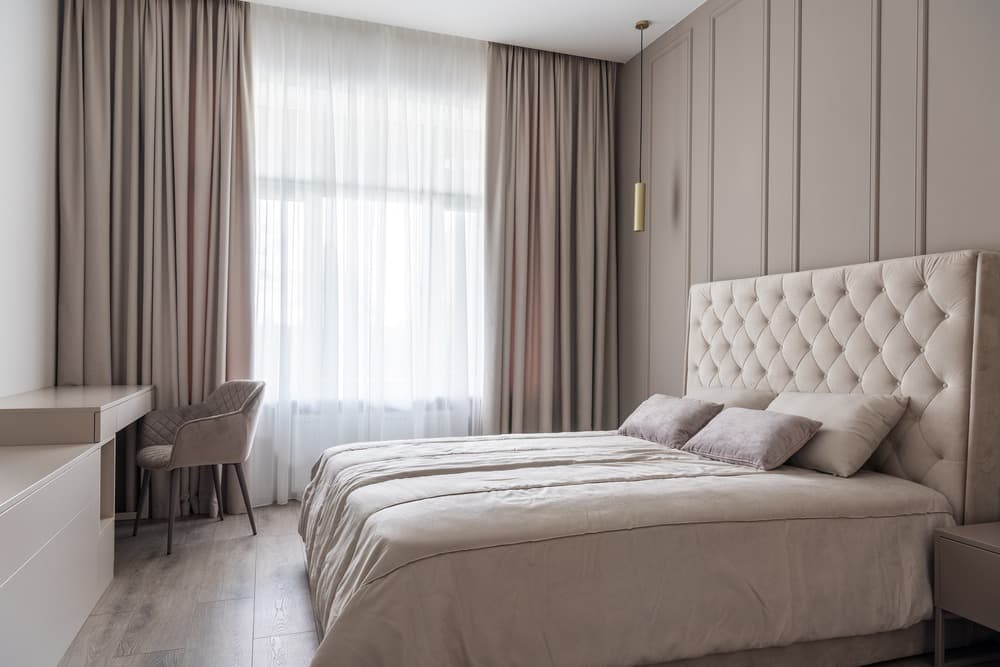
Upholstered hotel headboards are the workhorse of upscale and boutique rooms. Padded and wrapped in fabric, they give guests a soft, comfortable backrest and a warm, considered look in velvet, linen, faux leather or a performance weave. The trade is maintenance: upholstery has to be stain-resistant, fire-rated and easy to wipe, or it dates fast under hotel use. Specified well — treated fabric over high-density foam on a solid frame — an upholstered headboard reads luxurious and survives the housekeeping trolley at the same time. Pair it with a removable, washable cover where the property turns over hard, and the same panel stays fresh through far more stays.
Wooden and Veneered Headboards
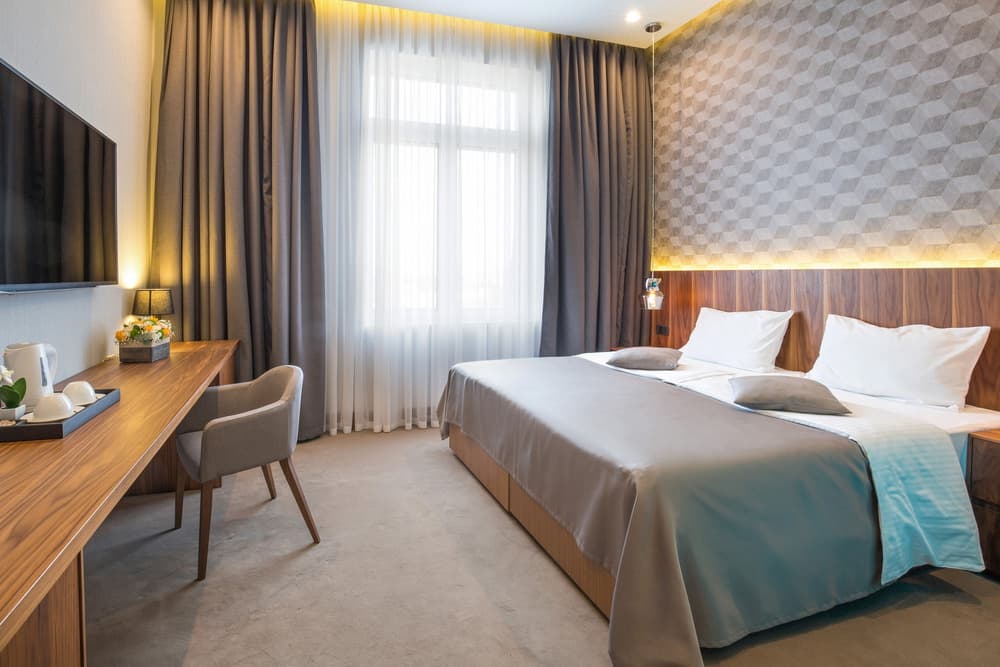
Wooden hotel headboards bring warmth and a classic, durable surface that wipes clean in seconds. A solid-timber or veneered panel suits mid-scale, rustic and modern properties, and it asks far less maintenance than upholstery — no fabric to stain, just an occasional dust and polish. Veneer over a stable contract core gives the look of real timber at a sensible cost, which is why it appears across so many chain and mid-market rooms. Where upholstery says soft and plush, wood says solid and low-fuss. For a busy mid-market property, that lower upkeep often outweighs the softer feel of upholstery, since a wooden panel rarely needs more than a wipe between guests.
Wall-to-Wall and Panel Headboards
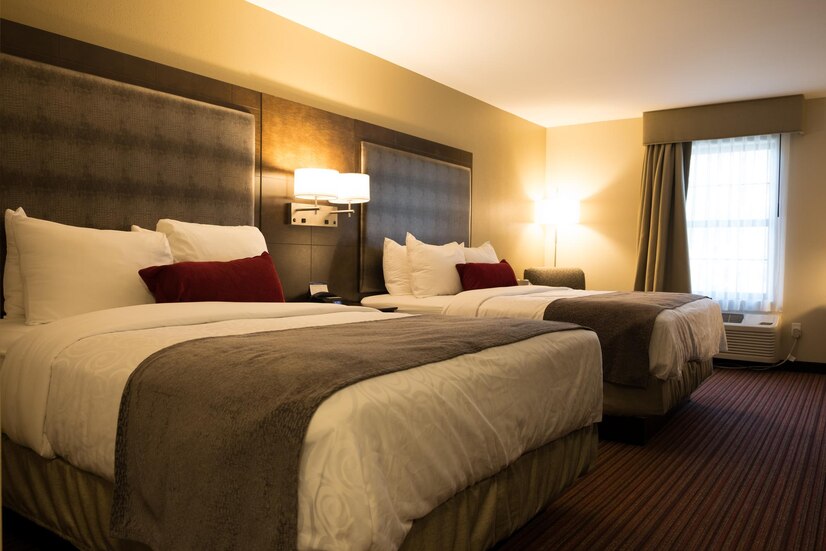
Beyond the single panel, two formats define modern hotel headboards. Wall-mounted panels — slim, sleek and floated above the bed — suit compact city rooms and read crisply contemporary. Full-width or wall-to-wall headboards run the whole bed wall, wrapping the bed in a cocooning, premium feel that suits suites and statement rooms. Both can carry integrated extras — reading lights, USB and power, even a slim shelf — turning the headboard into a functional piece as well as a focal point. The format follows the room: slim and floated where space is tight, full and enveloping where the room can carry it.
Metal and Statement Headboards
For properties chasing a sharper, more industrial look, metal hotel headboards offer a sleek, low-maintenance alternative. Powder-coated steel or brass frames suit minimalist, industrial and art-deco rooms, wipe clean in seconds and shrug off the wear that marks softer materials. The trade is comfort — bare metal gives no padding for a guest leaning back — so many designs pair a metal frame with an upholstered insert to get both the look and the backrest. Used well, a metal or mixed-material headboard becomes the statement piece a boutique room is built around, and it dates far more slowly than a trend-led fabric.
Choosing Hotel Headboards: What to Check
Choosing hotel headboards comes down to a short list of checks that decide whether a panel belongs in a guest room. Get these right and the look takes care of itself; skip one and a handsome headboard becomes a problem the first time housekeeping cleans it, an inspector checks it or a guest leans on it hard. Run every option past the same checklist before the order.
Material and Cleanability
Material is the first check, because a hotel headboard meets daily use and cleaning. For upholstery, choose abrasion-rated, stain-resistant fabric over high-density foam; for hard surfaces, a sealed timber or a quality veneer that wipes clean. Avoid delicate fabrics and untreated finishes that mark easily — in a high-turnover room they look tired within a season and drive up replacement costs. The rule is simple: if it cannot take a wet cloth and a thousand leans, it does not belong on a hotel bed. Performance fabrics rated for tens of thousands of rubs cost a little more and save the early replacement an untreated fabric forces.
Fire Rating and Compliance
Fire rating is the check no hotel can skip. Upholstered hotel headboards must meet the local fire-safety standard, which means fire-retardant fabric and foam, certified by the maker. A panel that fails compliance cannot go in a room however good it looks, so confirm the rating before anything else. A serious contract manufacturer supplies the certification as standard and will not ship upholstery that does not pass. Keep the certificates on file, too, because an inspector may ask for them long after the rooms open.
Size, Width and Height
Size is where a headboard either frames the bed or fights it. As a rule, the headboard should match or sit slightly wider than the mattress, so it anchors the bed rather than floating awkwardly behind it. Height is a design choice within practical limits — a taller panel reads grand and suits a high-ceilinged suite, a medium height keeps a standard room open and airy. Settle the size against the real bed and wall, not the render, so the proportion reads right once housekeeping dresses the room.
Frame, Foam and What Holds the Shape
The part of a headboard a guest never sees decides how long it lasts. Behind the fabric, a reinforced timber or engineered frame keeps the panel square, and high-density foam holds its shape under thousands of leans where a cheap foam flattens within a year. Ask what sits inside the panel, not only what wraps it — the frame and the foam separate a headboard that still looks plump in year five from one that sags by year two. On hard headboards, the equivalent check is the core and the edge banding, which decide whether a wooden panel takes knocks without chipping.
Fire rating is not optional, it is a pass or fail
An upholstered headboard that fails fire-safety regulations cannot go in a guest room, however good it looks. Contract upholstery uses fire-retardant fabric and foam to meet the local standard, and a serious maker certifies it. Treat the fire rating as the first gate a headboard has to clear, not a detail to confirm later — a beautiful panel that does not comply is a panel you cannot use.
Fixing, Height and Installation
A headboard is only as good as its fixing, and in a hotel the fixing has to repeat cleanly across every room. Good installation is invisible; bad installation shows up as a crooked panel, a rattle or a gap that collects dust. The two things to settle are how the headboard mounts and how high it sits.
Wall-Mounting and Brackets
Most hotel headboards hang on the wall using a cleat or bracket system — a rail fixed to the wall and a matching fitting on the panel, so the headboard lifts on and off for cleaning or replacement. The system has to carry the panel’s weight and fix into solid backing, not just plasterboard. Done well, wall mounting gives a clean, gap-free line, a consistent height across the property, and a panel that a single person can remove and refit in minutes. That ease matters more than it sounds: a panel one person can lift off gets cleaned behind and replaced on schedule, rather than left until it shows.
Headboard Height and Proportion
Height sets the feel of the bed wall. A standard panel typically runs somewhere between roughly eighty and one hundred and twenty centimetres above the mattress, while a tall, statement headboard climbs to a hundred and fifty or more in a suite with the ceiling to carry it. The taller the panel, the grander and cosier the room reads; the lower it sits, the sleeker and more modern. Fix the height once for each room type and hold it across the property, so every room of a type feels identical.
Installing Across Every Room
A headboard that installs beautifully once still has to install identically two hundred times, and the value of a wall-mounted system shows at that scale. A consistent bracket, a marked height and a repeatable fixing let a team fit a whole floor quickly and get the same clean line in every room. A maker who builds for hospitality supplies the hotel headboards ready to hang, with the fixing worked out, so the site team never improvises room by room. Plan the install as part of the order, and a hundred rooms go up as cleanly as the first.
Headboards That Last the Refurb Cycle
A good hotel headboard earns its place for the whole refurbishment cycle — seven to ten years of nightly use without sagging, staining or dating. Choose the type that suits the property, insist on cleanable and fire-rated materials, size and fix it properly, and the headboard quietly does its job for years. The headboard is one piece of the wider set, and our guide on how to choose hotel guest room furniture covers how it sits with the bed, nightstands and the rest. Specified as part of that set rather than bought alone, the headboard matches the room instead of merely sitting in it.
Bring in a manufacturer who builds hotel headboards to a contract standard — fire-rated, wall-mounted, custom to your brand, on FOB or CIF terms with a four-to-eight-week lead time and a two-year warranty — and the panel behind every bed holds its look as long as the room needs it to. Specify the headboard once, properly, and it keeps anchoring the room long after the doors open.
Foire aux questions
What kind of headboard do hotels use?
Most hotels use wall-mounted headboards rather than bolt-on ones, in upholstered or wooden finishes. Upholstered panels in cleanable, fire-rated fabric suit upscale and boutique rooms; veneered wooden headboards suit mid-scale properties. Wall mounting frees the floor, simplifies cleaning and survives constant use better than a residential bolt-on.
What factors should you consider when buying hotel headboards?
When buying hotel headboards, check the material and how easily it cleans, the fire rating for safety compliance, the fixing method, and the height and width against the bed. Contract-grade build and stain-resistant, fire-retardant upholstery matter more than the look alone, because the panel takes daily leaning and cleaning.
Are wall-mounted or bolt-on headboards better for hotels?
Wall-mounted headboards are better for most hotels. They keep the floor clear for cleaning, resist tampering, sit at a consistent height across every room, and install quickly at scale. Bolt-on headboards suit homes but loosen and shift under hotel use, and they trap dust where the bed meets the wall.
What is the best fabric for hotel headboards?
The best fabric for hotel headboards is a contract-grade, stain-resistant and fire-retardant upholstery such as a treated velvet, faux leather or a performance weave. It should clean easily, resist abrasion from constant leaning, and hold its colour under daily use. Looks come second to a fabric that survives the housekeeping trolley.
Why do hotels use padded headboards?
Hotels use padded headboards because guests sit up in bed to read, work or watch television, and a padded surface gives a comfortable backrest the wall cannot. Padding also softens the room, absorbs a little sound and reads as quality. Cleanable, fire-rated upholstery keeps that comfort practical for a hotel.
How tall should a hotel headboard be?
A hotel headboard usually sits roughly eighty to one hundred and twenty centimetres above the mattress for a standard panel, rising to a hundred and fifty centimetres or more for a tall, statement headboard in a suite. The width should match or slightly exceed the bed, and height is balanced against the ceiling and the look the room wants.