
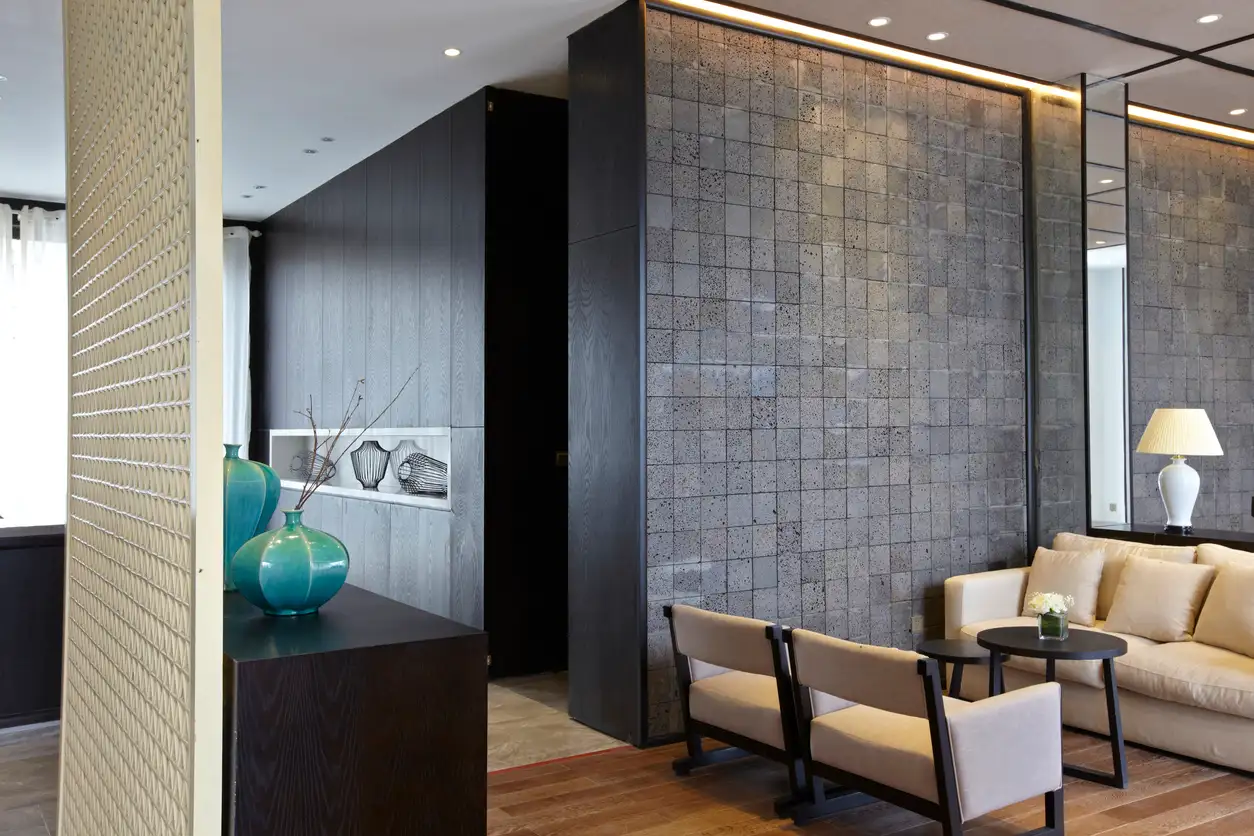
A hotel wall is the largest blank canvas in the building, and stone cladding turns it into the surface guests photograph and remember. A book-matched slab behind a reception desk, a backlit onyx panel in a bar, a stone facade that sets the tone before a guest reaches the door — these are the moments that define a property, and they are engineering as much as design. Choosing stone wall cladding well sits inside the wider natural stone for hotels framework that governs every surface, and this guide takes the wall specifically: the materials, the features, and the fixing that keeps them safe.
Definition
Stone wall cladding is a skin of natural stone fixed to a wall for appearance and protection, supplied as slabs, thin panels or tiles and mechanically anchored or bonded to the substrate. A feature wall uses that cladding to make a single wall the focal point of a space — a reception backdrop, a lift lobby or a bar front — often in book-matched or backlit stone.
Why Hotels Clad Walls in Stone
Cladding a wall in stone costs more than paint or paper, so it has to earn its place. In a hotel it earns it on impact, durability and the way a stone wall shields the surface behind it, which is why properties spend on a few walls out of proportion to their area.
The Wall That Makes the Photograph
Guests photograph the reception backdrop and the bar wall more than almost anything else in a hotel, and a stone feature wall fills those frames with depth a flat finish cannot match. That wall sells the property on social media and review sites long before a guest arrives, so the spend on stone cladding returns marketing value the rest of the build cannot. A strong feature wall lifts an ordinary space; a weak backdrop drags down a good one.
A Surface That Protects the Wall Behind It
Stone cladding is not only decorative. In lift lobbies, corridors and bar fronts where trolleys, luggage and constant contact batter a painted wall, a stone skin takes the abuse and shrugs it off. It resists knocks, cleans easily and never needs the repainting that high-contact walls demand every refurbishment, so the cladding pays back in maintenance saved as well as in looks.
Permanence the Brand Can Stand On
A stone wall reads as permanence, and that signal matters to a hotel brand. Where applied finishes date and get stripped out every few years, stone cladding holds its look across refurbishment cycles, so a property that invests in a stone reception wall keeps that statement for the life of the building. The material says the brand is here to stay, which is exactly the message a lobby exists to send.
Cladding Against Other Wall Finishes
Set stone cladding beside the alternatives and the contract case is clear. Paint is cheap but marks, scuffs and needs redoing every refurbishment in high-contact areas. Decorative panels and timber slats add warmth yet lack the permanence and the photograph-ready depth of stone, and many wear or date quickly. Large-format porcelain competes on durability, but on a seen feature wall it reads as a print rather than a material. Where a hotel wants a wall that lasts decades, takes contact and sells the space in pictures, stone cladding repays its higher cost over the years the others cannot match.
Clad the walls guests face, and clad those well. Stone spread thinly across every wall costs more and says less than one feature wall done right.
The stone rarely fails — the fixing does
When a clad wall fails in a hotel, the problem is almost never the stone; it is the fixing behind it. A heavy slab bonded to a weak substrate, or a panel without mechanical support, eventually loosens, bows or drops — a safety risk in a public space. Treat every stone feature wall as an engineered assembly, with the fixing system specified to the stone’s weight and the wall’s height, and the failure simply never happens.
Materials and Formats
Stone wall cladding comes in several materials and formats, and the choice balances the look a wall wants against the weight the structure can carry and the budget. The table sets the common formats against each other; the sections under it cover where each belongs.
Quick answer
What is stone wall cladding and where do hotels use it? Stone wall cladding is a skin of natural stone fixed to a wall for looks and protection. Hotels use it on reception backdrops, lift lobbies, bar and restaurant fronts, spa walls and exterior facades — anywhere a wall has to make an impression or take heavy contact. It comes as full slabs, thin panels, tiles or stacked stone, fixed by adhesive or mechanical anchors.
Full Slab Cladding
Large stone slabs give the most dramatic, seamless wall, with veining that runs unbroken and reads as pure luxury. Slab cladding suits reception backdrops and signature bar walls where the budget and the structure allow, and it is the format that lets a designer book-match two slabs into a mirrored pattern. Slabs are heavy and demand serious fixing, so they belong on engineered walls, not lightweight partitions.
Thin Stone Panels
Thin stone panels — stone bonded to a lightweight backing — cut the weight of full slabs dramatically while keeping a real stone face. They let a project clad more wall for less load and cost, which suits lift lobbies, corridors and feature walls on partitions that cannot carry solid slabs. Thin stone panels are how a hotel gets the stone look across large areas without the structural demands of full slabs.
Stone Tiles and Stacked Stone
Stone tiles clad walls economically and suit wet areas, spa walls and back-of-house feature zones where a modular format works. Stacked or split-face stone, set in courses, brings texture and shadow to a rustic or resort scheme and turns a wall into a tactile feature. Both formats are lighter and more forgiving to fix than slabs, so they spread stone across more of a property at a lower cost per square metre.
Stone Veneer Panels and the Faux Question
Stone veneer panels in real stone give a thin, lighter cladding for large areas, and they have a legitimate place in a contract scheme. Faux stone wall panels in resin or plastic are a different thing: they read as imitation up close, scratch and fade, and undercut the permanence a hotel wall exists to signal. A property trading on quality clads its seen walls in real stone and leaves faux panels to the budget retail market, where the lifecycle and the look matter less.
Choosing the Stone for a Feature Wall
The stone sets the character of the wall. Marble brings the veined drama a luxury lobby wants and book-matches into a mirrored image; travertine and limestone give a warm, calm, textured surface for resort and spa schemes; onyx unlocks the backlit, translucent feature; and slate or split-face stone delivers rugged texture and shadow. The wall’s job decides the stone — a statement reception backdrop reaches for marble or onyx, while a tactile spa wall suits travertine or stacked stone. Reading the brief before the swatch keeps the stone serving the space rather than fighting it.
| Format | Weight | Typical fixing | Best hotel use | Look |
|---|---|---|---|---|
| Full slab | Heavy | Mechanical anchors + support | Reception backdrops, signature bars | Seamless, book-matched, luxury |
| Thin stone panel | Light | Adhesive + mechanical aid | Lift lobbies, corridors, partitions | Real stone face, large areas |
| Stone tile | Light–medium | Adhesive bed | Wet areas, spa, modular features | Modular, repeatable |
| Stacked / split-face | Medium | Mechanical + adhesive | Rustic, resort, textured features | Textured, shadowed |
| Stone veneer panel | Very light | Adhesive / rail system | Large feature areas, lighter walls | Thin real-stone skin |

Feature Walls That Sell the Space
A feature wall is cladding with intent: one wall made the focal point of a space. Hotels build their identity on a handful of these, and the technique chosen decides how much the wall does for the room.
Book-Matched Stone Feature Walls
Book-matching opens two consecutive slabs like the pages of a book so their veining mirrors into a symmetrical pattern, turning a reception backdrop into a single dramatic image. A book-matched stone feature wall is the signature move of a luxury lobby, and it demands slabs reserved from the same block and a fabricator who lays out the cut precisely. Done well, it is the most photographed surface in the building.
Backlit Onyx and Translucent Stone
Onyx and some marbles are translucent, so lighting them from behind turns a wall into a glowing feature. A backlit onyx feature wall behind a bar or reception desk reads as pure luxury after dark and gives a property a signature no competitor can copy. It demands a translucent stone, an even LED light box behind it and careful detailing, but the effect carries a whole space.
Reception, Lift Lobbies and Bar Fronts
The walls that earn cladding are the ones guests face and touch. A reception feature wall sets the tone at check-in; lift lobbies, repeated on every floor, multiply a stone detail across the building; and a clad bar front takes contact and reads as quality at once. Choosing which walls to clad — and cladding those well rather than spreading stone thinly — is what makes the budget land where guests actually look.
Scale, Proportion and the Reveal
A feature wall succeeds or fails on proportion as much as material. A grand reception backdrop wants large slabs and few joints so the eye reads one surface; a tighter lift lobby suits a smaller-format or a single bold panel. The reveal — how the stone meets the ceiling, the floor and the adjacent walls — decides whether the wall looks built-in or stuck-on. Detailing a shadow gap, a clean return or a flush edge is what makes a clad wall read as architecture rather than decoration, so the proportion and the edges belong in the design from the first sketch.
Reserve the block before you design the book-match
A book-matched feature wall only works if the slabs come from the same block, in sequence. The mistake that kills these walls is designing the mirrored pattern first and sourcing the stone later, when the matching slabs are gone. On a feature-wall project, the block gets reserved and the slabs sequenced before the design is finalised, so the veining a render promised is the veining that arrives on site.
Fixing, Weight and Safety
The fixing is where a clad wall is made safe or unsafe, and in a public building it carries real liability. How the stone attaches depends on its weight, the wall height and the substrate behind it.
Adhesive, Mechanical and Ventilated Systems
Three approaches cover most hotel cladding. Adhesive bonding suits lighter tiles and thin panels on sound substrates, where the bond carries the load. Mechanical fixing — anchors, clips or a rail system — supports heavier slabs and tall walls, holding the stone independently of any adhesive. A ventilated facade system hangs stone on a frame with an air gap behind, which suits exteriors and large interior walls and manages moisture. The format and weight of the stone decide which system a wall needs.
Weight, Substrate and Structural Load
Stone is heavy, and a wall has to carry it. The spec checks the weight per square metre against what the substrate and structure can take, and reinforces or reframes the wall where a heavy slab demands it. A lightweight partition will not carry a full slab without backing, which is exactly where thin panels or veneer earn their place. Getting the structural load agreed early stops a beautiful design from meeting a wall that cannot hold it.
Safety in a Public Building
A loose stone panel over a guest is a serious hazard, so cladding in a hotel follows a higher safety bar than a home. Mechanical support or a secondary fixing on heavy and high-level stone, tested fixings and a competent installer are not optional. The cost of doing fixing properly is small against the consequence of a panel failing in a public space, which is why the safety case leads the cladding spec.
Joints, Tolerances and Movement
Stone moves with temperature and the building settles, so a clad wall needs joints and tolerances designed in. Tight, consistent joints read as quality, but the spec still allows for movement so panels do not crack or push against each other, and it sets out where joints fall so they land logically rather than mid-pattern. On a book-matched or large-format wall, the joint layout is part of the design, planned with the fabricator so the veining and the joints work together rather than against each other.
Corners, Returns and Edges
The detail that separates a crafted clad wall from a clumsy one is how the stone turns a corner. A mitred return makes the stone look solid and continuous, where a butt joint exposes the thin edge and reveals the cladding for what it is. Window reveals, door surrounds and external corners all need their edge detail drawn and agreed, because these are the points a guest sees close up. Specifying the corner and edge treatment, not just the face stone, is what keeps a feature wall convincing at arm’s length.
Interior, Exterior and Wet Zones
Where a clad wall sits changes the stone, the fixing and the detailing. Three settings cover most hotel cladding, and each sets its own brief.
Exterior Stone Cladding and Facades
A stone facade sets a guest’s first impression before they reach the door, and exterior stone cladding gives a hotel the permanence and presence a rendered wall cannot. Facades demand a durable, weather-resistant stone, a ventilated fixing system that manages wind load and moisture, and detailing for movement and drainage. The engineering is more demanding than interior work, so exterior cladding belongs with a specialist, but the result defines the building.
Wet Zones: Spa, Pool and Bathroom Walls
Spa walls, pool surrounds and bathroom features take constant moisture, so the stone and its fixing have to handle water. A dense, well-sealed stone resists staining, and the fixing and waterproofing detail behind the cladding stop moisture tracking into the structure. Hygienic, easily cleaned stone walls suit spa and wellness zones where the surface has to look immaculate and wipe down, which makes cladding a natural fit for these high-end wet areas.
Interior Features and Acoustics
Interior feature walls are the most common cladding and the most forgiving, but they still interact with the space. A hard stone wall reflects sound, so a lobby that clads a large wall balances it with soft furnishings and acoustic treatment elsewhere. Detailing the edges, returns and joints cleanly is what separates a considered feature wall from one that looks applied, so the interior brief is as much about finish detail as about the stone itself.
Lighting a Stone Wall
Light makes or breaks a stone feature wall. Grazing light raked across a textured or stacked-stone surface throws shadow and brings the relief alive, while flat, even light on a polished marble shows its veining and depth. Backlighting turns translucent onyx into a glowing feature after dark. The lighting design and the cladding belong together, because the same wall can look flat under the wrong light and spectacular under the right one, and coordinating the two early is what delivers the effect a render promised.
Keeping a Clad Wall Looking New
A stone feature wall is low-maintenance, not no-maintenance. Dust and fingerprints settle on a reception backdrop, and a bar or spa wall meets splashes, so housekeeping wipes seen cladding with a pH-neutral cleaner and keeps acidic products off it just as on any stone surface. Porous stone on the wall takes a periodic seal, and a quick check of the joints and fixings during each refurbishment catches any movement early. That light routine keeps a clad wall reading as new for the decades it is built to last.
Planning Cladding into the Build Programme
Cladding touches structure, services and finishes, so it has to land in the programme early rather than as a late dressing. The wall behind it may need reinforcing, any backlighting or recessed services have to be set before the stone goes on, and slab reservation for a book-match runs to a long lead. Coordinating the cladding with the structural, lighting and fit-out trades from the outset is what stops a feature wall from clashing with a service run or arriving after the matching slabs are gone.

Specifying and Sourcing
A clad wall is a coordinated package — stone, fabrication, fixing and installation — delivered on a construction programme. Getting it right takes a supplier who handles the whole chain rather than just the stone.
The questions that protect a cladding project are direct: can the supplier reserve and sequence the slabs for a book-match, fabricate the panels to size, supply the fixing detail and support the installer, and deliver in phase with the build? Sourcing the stone and the fixing approach together from one partner keeps the design intent intact from render to wall. For the commercial range of contract cladding and feature panels, the made-in-Turkey stone wall cladding line is built for hospitality walls and facades, and the wider natural stone for hotels pillar frames how the wall sits within every other surface in the property.
Pairing the right stone with a maker who handles slab selection, fabrication, fixing detail and installer support turns a bold design into a wall that arrives as drawn and stays safe for the life of the building. The feature wall specified at opening then carries the property’s identity through every refurbishment, reading the same in the photographs that sell the hotel as it does on site.
Frequently Asked Questions
What is stone wall cladding?
Stone wall cladding is a skin of natural stone fixed to a wall for both appearance and protection. It is supplied as full slabs, thin stone panels, tiles or stacked stone, and fixed to the substrate with adhesive, mechanical anchors or a ventilated frame. In hotels it turns reception backdrops, lift lobbies, bar fronts and facades into durable brand statements.
Where do hotels use stone wall cladding and feature walls?
Hotels clad the walls guests face and touch: reception backdrops, lift lobbies repeated on every floor, bar and restaurant fronts, spa and pool walls, and exterior facades. These are the surfaces that make a first impression or take heavy contact, so a durable stone skin earns its cost there while the rest of the walls stay in paint or paper.
How is stone wall cladding fixed to the wall?
Stone cladding is fixed by adhesive bonding, mechanical anchors or a ventilated frame system, depending on weight and height. Lighter tiles and thin panels bond to a sound substrate, while heavy slabs and tall walls need mechanical support that carries the stone independently. In public buildings, heavy and high-level stone takes a secondary mechanical fixing for safety.
How long does stone cladding last?
Properly fixed and sealed natural stone cladding lasts for decades and outlives the applied finishes around it, riding through several refurbishment cycles. Its lifespan depends far more on the fixing and detailing than the stone: a well-anchored, well-drained wall lasts the life of the building, while a poorly fixed one can fail in years.
Is stone cladding cheaper than solid stone?
Yes. Cladding uses a thin skin of stone rather than solid blocks, so it delivers the look of stone for far less material, weight and cost. Thin stone panels and veneer cut the weight further, which also reduces structural and fixing costs. For walls, cladding is how hotels get a real stone surface without the price or load of solid stone.
What are the disadvantages of stone cladding?
Stone cladding costs more than paint or paper upfront, adds weight that the wall must carry, and depends on correct fixing for safety, so it needs proper engineering and a competent installer. Porous stone also needs sealing. A contract spec answers each: lifecycle cost favours stone, the fixing is engineered to the load, and a sealing regime protects the surface.
Is natural stone cladding better than faux stone panels for hotels?
For seen walls in a hotel, natural stone is the stronger choice. Faux stone wall panels in resin or plastic read as imitation up close, scratch and fade, and undercut the permanence a hotel wall is meant to signal. Real stone cladding holds its look for decades and photographs as genuine, which is why quality properties clad their feature walls in natural stone.
Can stone cladding be used on hotel exteriors and facades?
Yes. Exterior stone cladding gives a hotel facade permanence and presence, but it demands a weather-resistant stone, a ventilated fixing system that handles wind load and moisture, and detailing for movement and drainage. The engineering is more demanding than interior cladding, so a facade belongs with a specialist, but the result defines the building from the street.