
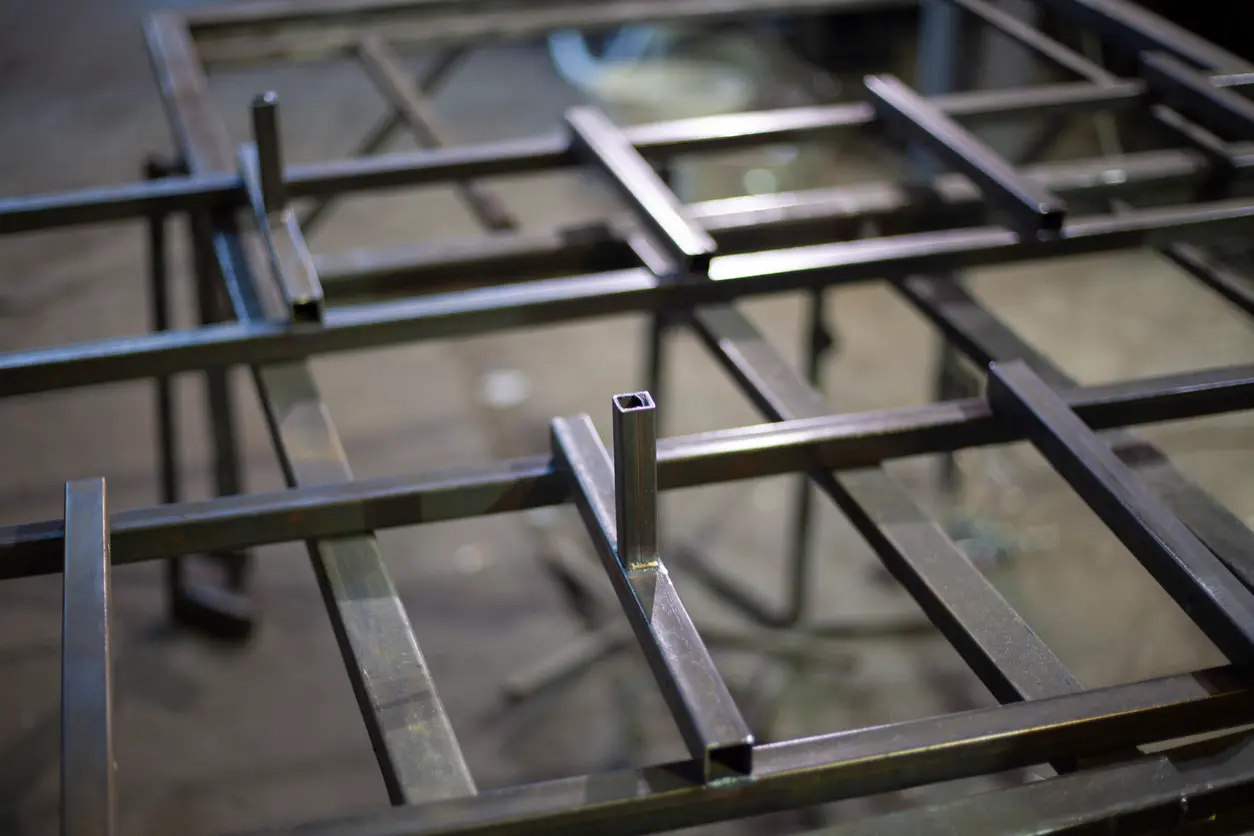
A welded steel frame is the quiet reason a contract chair survives what a domestic one cannot. Where a home frame relies on screws and brackets that work loose, a welded frame fuses its tubes into a single rigid structure with nothing to slacken under constant use. That construction is fundamental to contract metalwork, and it sits inside the wider metal in hotel furniture and interiors guide that frames how a property specifies steel across its furniture and fit-out. This article takes the welded steel frame specifically: how it is built, what separates a good weld from a bad one, and what a buyer should check before an order ships.
Definition
A welded steel frame is a furniture structure made by fusing steel tubes or sections together with welds, rather than joining them with bolts or fasteners. The welding melts the metal at each joint so the parts become one continuous piece, giving a rigid, fastener-free frame that carries heavy, repeated loads — which is why it underpins most contract seating, tables and bases.
Why Contract Furniture Is Welded
Contract furniture lives a harder life than any home piece, and the way its frame is joined decides whether it keeps up. Welding answers the central problem of heavy use: every bolted joint is a point that can loosen, and a frame full of them eventually wobbles. A welded frame removes those points entirely, which is why makers reach for it wherever furniture has to stay tight through years of constant use.
One Rigid Piece, Nothing to Loosen
A welded steel frame behaves as a single component. The welds fuse the tubes so the frame resists racking — the twisting that works a chair loose — far better than any fastened joint. There are no screws to back out, no brackets to fatigue, and no annual tightening for maintenance to chase. For a banquet chair sat in thousands of times or a table dragged daily, that fastener-free rigidity is the difference between a frame that stays tight and one that starts to creak within a year.
Strength Where the Loads Concentrate
Loads in furniture concentrate at the joints — where a leg meets a seat rail, where an arm meets a back. A weld puts solid, continuous metal exactly at those points, so the frame carries the load through fused steel rather than through a bolt and a hole that the bolt slowly elongates. Done well, the joint becomes the strongest part of the frame instead of its weak link, which lets a designer use slimmer tube and still pass the load and fatigue tests contract seating must meet.
Contract Frames Are Not Flat-Pack Frames
A flat-pack or knock-down frame ships in pieces and assembles with fasteners, which suits a home and a courier but not a hotel ballroom. A fully welded steel frame arrives complete and ready to work, with no assembly to get wrong on site and no fasteners to loosen later. The trade is freight volume, since a welded frame ships assembled, but for furniture that has to perform under contract use the welded frame is the standard the others are measured against.
Quick answer
Why use welded steel frames in contract furniture? Because they have no fasteners to loosen. A welded steel frame fuses into one rigid piece that resists racking under heavy hotel use, needs no maintenance tightening and puts solid metal at the high-stress joints. That is why banquet, stacking and heavy-use seating run on welded steel rather than bolted or flat-pack frames.
What Welding Removes from the Maintenance List
Every bolted joint is a future maintenance task: a fastener to check, a bracket to retighten, a wobble to chase across a property of hundreds of chairs. Welding deletes that list. A fully welded frame has nothing for housekeeping or maintenance to tighten, so it drops out of the planned-maintenance schedule entirely and frees the team to work on the things that genuinely wear. Over a building’s life, that removed labour is a real saving the purchase price never shows.
A bolted joint is a maintenance appointment waiting to happen. A weld is a joint you never have to think about again.
The weld you cannot see is the one that fails
A tack weld dressed smooth and painted over looks identical to a full, continuous weld — until the frame is loaded and the tack lets go. The most common hidden defect in cheap contract furniture is a weld that bridges the joint cosmetically without fully fusing it. A buyer cannot see this once the frame is coated, which is why it pays to specify continuous, full-penetration welds and to trust a maker whose welding you can inspect before finishing.
Welding Processes and Joints
Not all welds are made the same way, and the process and joint design shape the strength, look and cost of a frame. A specifier does not need to weld, but understanding the choices helps read a quote and a sample.
MIG Welding for Speed and Strength
MIG welding feeds a wire electrode continuously, laying down metal fast with strong, consistent results. It is the workhorse of contract furniture because it welds the mild steel tube most frames use quickly and cleanly, which keeps a volume order affordable. A MIG welded steel frame gives the strength contract seating needs at a production speed that suits hundreds of identical pieces, so most hotel furniture frames are MIG welded.
TIG Welding for the Visible Joint
TIG welding is slower and more precise, giving a cleaner, finer weld bead that suits stainless steel and any joint left visible rather than hidden under upholstery or coating. Where a frame shows its welds — a polished stainless base, an exposed-frame lounge chair — a TIG welded steel frame reads as crafted rather than industrial. It costs more per joint, so makers reserve it for visible and stainless work where its finish earns the time.
Joint Design: Mitres, Gussets and Sleeves
How the tubes meet matters as much as the weld itself. A mitred joint cuts both tubes at an angle so they meet cleanly for a neat, strong corner; a gusset or an internal sleeve adds reinforcing metal inside a high-stress joint to spread the load. The best frames design the joint for the force it carries rather than simply butting two tubes together, so a heavily loaded leg-to-seat junction gets the reinforcement a lightly loaded one does not. Joint design is where an engineer earns their keep on a contract frame.
Tube Sections and Wall Thickness
The tube the frame is built from sets its strength as much as the welding. Contract frames use round, square or rectangular hollow section — the slim, strong tube that gives the most rigidity for the least weight — and the wall thickness is chosen for the load each member carries. A leg takes a heavier-gauge tube than a stretcher, and under-gauging to save cost is a common reason a cheap frame flexes. The spec names the section and the wall thickness, because two frames of the same shape can perform very differently depending on the tube inside them.
Why Hollow Tube, Not Solid Bar
Hollow steel tube carries bending and twisting loads far more efficiently than solid bar of the same weight, because the strength of a section lives in its outer walls. That is why contract frames are built from tube rather than solid stock: a hollow section gives the rigidity a chair needs at a fraction of the weight and cost of solid steel. It also welds cleanly and takes a powder coat evenly, so the hollow tube is both the lighter and the better-performing choice for a furniture frame.
| Measure | Fully welded | Knock-down / bolted | Hybrid (welded + bolted) |
|---|---|---|---|
| Rigidity | Highest — no joints to loosen | Lower — fasteners can slacken | High at welded sections |
| On-site assembly | None — ships complete | Required | Partial |
| Freight volume | High (assembled) | Low (flat-packed) | Medium |
| Field repair | Hard (re-weld) | Easy (re-tighten/replace) | Mixed |
| Best contract use | Banquet, stacking, heavy-use seating | Bulk shipping, modular pieces | Large items needing some break-down |
Custom and One-Off Welded Frames
Welding suits bespoke work as well as volume. Because a welded frame is built from cut tube held in a jig, a maker can produce a custom welded steel frame straight from a designer’s drawing without the expensive tooling a moulded or cast part would demand. That keeps one-off feature seating and signature pieces viable at a sensible cost, and the same process scales without changing: a property specifies a custom welded frame for a lobby statement chair and a standard welded frame for the guest rooms, both from the one workshop, both built the same way. For a contract project that mixes signature and volume pieces, that flexibility is part of why welded steel stays the default.

What Good Weld Quality Looks Like
Two frames can look identical and perform completely differently, because the quality is in the welding. Knowing what good looks like lets a buyer judge a sample rather than trust a photograph.
Continuous, Full-Penetration Welds
A strong joint uses a continuous weld that runs the length of the seam and penetrates fully into the metal, fusing the tubes through their thickness rather than skinning the surface. Stitched or tacked welds — short beads with gaps between — cost less and look fine once dressed, but they concentrate stress and fail under load. On a contract frame, the spec should call for continuous welds at the load-bearing joints, because that is where a cut corner shows up first.
The Jig That Keeps Every Frame Square
Welding pulls metal as it cools, so a frame welded freehand drifts out of square and no two match. A welding jig clamps the tubes in exact position while the welder works, so every frame comes out identical, square and flat. For a hotel order of hundreds of chairs, that jig is what guarantees they stack, align and sit level as a set. A maker without proper fixturing cannot hold consistency across a contract run, which is why the jig matters as much as the welder.
Dressing and Stress Relief
After welding, the beads at visible joints are ground and dressed smooth so the finished frame reads as one clean piece, and any sharp spatter is removed for safety. On heavily loaded or precision frames, stress relieving — controlled heating that settles the metal — removes the internal tension welding leaves behind, so the frame holds its shape over time. These finishing steps are invisible in the final piece but decide whether it stays true and safe in service.
Load and Fatigue Testing
Contract seating has to pass strength and fatigue tests that a domestic frame never meets, cycling a load onto the chair tens of thousands of times to prove it will not fail in service. A welded frame that passes these tests has demonstrated its joints, not just claimed them, which is why reputable contract makers test to recognised hospitality furniture standards. Asking for the test evidence is a fast way to separate a frame engineered for contract life from one that merely looks the part.
Reading a Frame Sample
A buyer can judge a frame without a workshop. Turn a sample over and look at the welds at the load-bearing joints: they should be continuous, even and free of pinholes, not short tacks with gaps. Check that the frame sits flat and square on a level surface, that stacking chairs nest cleanly, and that no sharp spatter remains. On a coated sample, press and flex the frame for any give. These few checks reveal more about the frame’s life ahead than any brochure.
The jig is why two hundred chairs match
The hidden enabler of a consistent contract order is the welding fixture. Hand-built frames vary just enough that a stack leans or a set of chairs sits at slightly different heights, and the inconsistency shows the moment they line up in a ballroom. A maker who builds a dedicated jig for the order produces frames that are interchangeable to the millimetre. When a sample looks perfect, the real question is whether the two-hundredth frame will match it — and the jig is the answer.
Welded vs Knock-Down Construction
Welded is not the only way to build a steel frame, and the alternative has its place. Reading the two honestly puts welded construction where it belongs and saves it where it does not.
Where Welded Wins
Welded construction wins wherever the furniture takes heavy, repeated load and has to stay tight for years — banquet and stacking chairs, bar stools, table bases, and any seating that staff handle roughly. The fastener-free rigidity and the absence of maintenance tightening pay back across the life of the piece. For the core seating that defines a hotel’s durability, welded steel is the default, and the freight cost of shipping it assembled is small against the performance.
Where Knock-Down Makes Sense
Knock-down construction earns its place on large items where freight and access dominate — big tables, bed bases and modular pieces that would be costly or impossible to move assembled. A well-engineered bolted joint, with locking fasteners and proper tolerances, holds acceptably on items that do not see the racking loads a chair does. The mistake is using knock-down on heavy-use seating to save shipping, where the loosening it invites costs more in failures than the freight ever saved.
Hybrid Frames in Practice
Many contract pieces combine both. A large welded sub-frame can bolt to welded legs, or a welded seat frame can attach to a knock-down base, so a maker welds the parts that carry load and bolts the parts that need to break down for transport. Designing where the welds stop and the fasteners start is an engineering decision, and a good frame uses each method where it serves rather than committing the whole piece to one. This pairs with the wider frame-material choice covered in steel vs aluminium vs wood furniture frames.
Finishing, Corrosion and Repair
A welded frame is raw steel until it is finished, and what happens after the welding decides how it survives moisture and wear.
Powder Coating Over the Welds
Welded steel frames are almost always powder coated, which gives a tough, even, colour-matched skin far more durable than wet paint. The welds have to be dressed smooth first, because powder coat follows the surface beneath it and a rough or pitted weld telegraphs through the finish. A properly prepared and powder-coated welded steel frame resists chips and everyday corrosion well, and the coating is the frame’s main defence, so its preparation and quality matter as much as the welding.
Corrosion and Where Steel Belongs
Steel rusts wherever its coating is breached, and a weld is a vulnerable spot if it is left rough or porous. For dry indoor furniture, a quality powder coat over clean welds handles corrosion for years. For damp or wet settings, a stainless steel welded frame resists corrosion far better and suits spa, wet and some outdoor pieces, though it costs more and welds more slowly. Matching the steel and its finish to the moisture the piece will meet is what keeps rust from starting at the welds.
Repair and the Long View
A welded frame is harder to repair in the field than a bolted one, since fixing it usually means re-welding, stripping and re-coating — work for a workshop, not a maintenance cupboard. The flip side is that it rarely needs repair: a well-built welded frame simply does not develop the loose joints that send bolted furniture for fixing. Over the life of the piece, the welded frame trades field-repairability for not needing repair in the first place, which suits the contract setting where downtime and call-outs cost more than the occasional workshop job.
Weight and the Trade-Off
Welded steel’s strength comes with weight, and a spec has to weigh that against handling. A welded steel frame is heavier than an aluminium one, which matters for furniture staff move and stack constantly, so a property balances the rigidity steel gives against the daily labour of moving it. The answer is rarely steel everywhere; it is steel where loads and rigidity lead, and lighter materials where handling dominates. Pricing the handling alongside the strength keeps the frame matched to how the piece actually gets used.

Specifying and Sourcing
A welded steel frame is only as good as the workshop behind it, so sourcing matters as much as design. A contract order rewards a maker who controls cutting, jigging, welding, dressing and coating under one roof.
The questions that protect a frame order are direct: does the maker build a jig for the run, weld continuously at the load-bearing joints, dress and stress-relieve where it counts, and prepare the welds properly before powder coating? Asking to inspect a raw, uncoated frame tells a buyer more than any finished sample, because the coating hides the welds. Sourcing the frames from a single contract metalworker keeps the welding, finishing and consistency in one pair of hands. For the commercial range of welded steel and stainless contract frames, the made-in-Turkey contract metalwork line is built for hospitality projects, and the wider metal in hotel furniture and interiors pillar frames how the frame fits the rest of a property’s metalwork.
Pairing a sound frame design with a workshop that controls every stage — cutting, jigging, welding, dressing and coating — turns a drawing into furniture that survives the use it was bought for. The welded frame specified at the start then carries the piece through reupholstery after reupholstery, staying as tight and square at year ten as it was on the day it shipped.
Frequently Asked Questions
What is a welded steel frame in furniture?
A welded steel frame is a furniture structure made by fusing steel tubes together with welds rather than joining them with bolts. The welding melts the metal at each joint so the parts become one continuous piece, giving a rigid, fastener-free frame that carries heavy, repeated loads. It underpins most contract seating, stools, tables and bases.
Why do contract furniture makers use welded steel frames?
Because welded frames have no fasteners to loosen. A welded steel frame behaves as one rigid piece, resisting the racking that works bolted furniture loose under heavy hotel use. It needs no maintenance tightening, stays square for years, and puts solid metal at the high-stress joints, which is why banquet, stacking and heavy-use seating rely on it.
What is the difference between a welded frame and a knock-down frame?
A welded frame is fused into one solid piece and ships assembled, while a knock-down frame bolts together from parts on site. Welded frames are more rigid and need no tightening, so they suit heavy-use seating; knock-down frames ship flat and cost less to freight, so they suit large items where transport and access matter more than maximum rigidity.
Are welded steel frames stronger than bolted ones?
For resisting racking and staying tight, yes. A welded joint puts continuous solid metal at the connection, so it does not loosen the way a bolt through a hole eventually does. A well-engineered bolted joint holds acceptably on low-stress items, but for the repeated loads of contract seating, welded construction gives more rigidity and a longer service life.
Do welded steel furniture frames rust?
Bare steel rusts, so welded frames are powder coated to protect them, and a properly prepared, well-coated frame resists everyday corrosion for years. Rust tends to start where the coating is breached or where a rough weld was poorly prepared. For wet or outdoor settings, a stainless steel welded frame resists corrosion far better than coated mild steel.
MIG or TIG welding for furniture frames — which is better?
Both have a place. MIG welding is faster and strong, so it suits mild-steel frames produced in volume, which covers most hotel furniture. TIG welding is slower but cleaner and finer, so it suits stainless steel and any joint left visible. Makers MIG weld hidden structural frames and TIG weld exposed or stainless work where the bead shows.
Can welded steel frames be powder coated?
Yes, and they almost always are. Powder coating gives a welded steel frame a tough, even, colour-matched finish that resists chips and corrosion far better than wet paint. The welds must be dressed smooth and the frame cleaned first, because powder coat follows the surface beneath it, so a rough weld shows through the finish if it is not prepared.
Are welded steel frames repairable?
They are repairable, but usually in a workshop rather than on site, since fixing a welded frame means re-welding, then stripping and re-coating the area. The advantage is that a well-built welded frame rarely needs repair, because it does not develop the loose joints that send bolted furniture for fixing. It trades field-repairability for not failing in the first place.