
Marble or granite is the oldest question in stone, and in a hotel it has a precise answer that depends entirely on where the stone goes. Marble carries the veining and luxury that defines a five-star lobby; granite carries the hardness that survives luggage wheels and spilled wine. Confuse the two — put soft marble on a busy floor or heavy granite where a feature wall needed drama — and the project pays for it within a year. This guide compares marble vs granite the way a specifier should: by how each stone forms, how it behaves under traffic and acid, what it costs to live with, and which surfaces in a hotel each one belongs on. For the wider stone palette and the rest of the families, the natural stone for hotels pillar and the types of natural stone guide set out the full picture; this article settles the two-stone decision.
In short
Marble vs granite comes down to looks against durability. Marble is a softer, porous metamorphic stone prized for veining and luminosity; granite is a hard, low-porosity igneous stone that resists scratching, staining and etching. Marble belongs on the surfaces a hotel shows off and shields; granite belongs where the surface takes active wear. Most hotels specify both, each in the zone its strengths fit.
Where marble and granite come from
The whole comparison flows from how the two stones formed, so it pays to start there. Marble and granite behave differently in a hotel because they are chemically and structurally different rocks, and once the formation is clear, every practical difference that follows makes sense.
Marble: a metamorphic stone
Marble begins as limestone and transforms under heat and pressure deep in the earth, recrystallising its calcium carbonate into an interlocking mosaic of calcite crystals. That process gives marble its translucency, its depth and the veining that runs through it like movement frozen in stone. It also leaves marble made of calcium carbonate — a mineral that is relatively soft and chemically reactive, which explains both the beauty and the care marble demands. The veining that makes each slab unique is the same structure that makes marble a surface to show off and protect rather than punish.
Granite: an igneous stone
Granite forms the opposite way, crystallising slowly from cooling magma into interlocking crystals of quartz, feldspar and mica. Those silicate minerals are hard and chemically stable, which gives granite its density, its scratch resistance and its immunity to the acids that mark marble. The result reads as a granular, speckled surface with depth and texture rather than flowing veins — grounded and solid where marble is luminous and fluid. Everything granite does well in a hotel traces back to this igneous, silicate structure.
Hardness, porosity and the etching difference
Three properties decide how each stone holds up in a hotel, and on all three the stones diverge sharply. Understanding them is what turns the marble-vs-granite choice from a matter of taste into a matter of specification.
Hardness and scratching
Hardness, measured on the Mohs scale, is the clearest gap between the two. Granite sits at 6 to 7, marble at around 3, and that difference shows up the moment grit meets the floor. The same grain of sand a guest tracks in on a shoe is harmless under granite and leaves a fine scratch on polished marble. Over years of traffic, those scratches accumulate into the network designers call patina — a living finish to some, a maintenance concern to others. Granite simply shrugs the grit off, which is why it carries the busiest floors in a property without showing its age.
Porosity and staining
Porosity decides how easily a stone stains. Granite is one of the densest natural stones, with an absorption rate often under half a percent, so a spill sits on the surface and gives housekeeping a generous window to wipe it up. Marble is significantly more porous, pulling liquids in faster, so a spill left on marble can stain before anyone reaches it. Both stones seal to slow absorption, but granite starts from a far more forgiving baseline — a real advantage in a high-traffic, high-risk environment where spills are routine and attention is not.
The etching difference
The most important difference between the two stones is the one specifiers most often miss: etching. Marble is calcium carbonate, so acids react with it chemically — citrus, wine, coffee, vinegar and many cleaning products all leave a dull etch mark where they touch, and even brief contact is enough. Granite is silicate and chemically stable, so the same acids leave it untouched. Granite does not etch, full stop, and that single property is its greatest functional advantage over marble on any surface that meets food, drink or cleaning chemicals. For a bar top or a working counter, this difference alone often decides the choice.
Heat and chemical resistance
Two more properties matter where stone meets a working environment, and both favour granite. Granite handles heat exceptionally — a hot pan or a dish straight from the oven leaves it unmarked — while marble tolerates heat well but, as a softer stone, takes more care around it. On cleaning chemistry the gap is wider: granite shrugs off the broad range of products a busy hotel cleans with, whereas marble reacts to anything acidic and demands strictly pH-neutral, stone-safe cleaners. For a hospitality kitchen or a bar where hot vessels, spills and frequent commercial cleaning are the daily routine, granite’s heat and chemical resilience makes it the practical surface, and marble belongs where the contact is gentler and the care more controlled. Reading these two alongside hardness and etching completes the durability picture between the stones.
Sealing protects marble from stains, not from etching
The most expensive misunderstanding in stone specification is the belief that sealing makes marble bulletproof. A sealer reduces porosity, so it slows staining and buys time to wipe a spill — but no sealer on the market stops the acid-etching reaction on calcium carbonate. A sealed marble surface etches from a splash of lemon or a sweep of acidic cleaner exactly as fast as an unsealed one. Specify marble for a surface that meets acids, and you accept etching as part of the deal, sealed or not. Where that is unacceptable — a busy bar, a coffee station, a working counter — granite is the honest answer, because its resistance comes from chemistry, not from a coating that wears off.
| Property | Marble | Granite |
|---|---|---|
| Rock type | Metamorphic (from limestone) | Igneous (from magma) |
| Main mineral | Calcium carbonate (calcite) | Silicates (quartz, feldspar) |
| Hardness (Mohs) | ~3 — scratches | ~6–7 — scratch-resistant |
| Porosity | Medium–high | Low (often under 0.4%) |
| Acid / etching | Etches from acids | Does not etch |
| Heat resistance | Good | Excellent |
| Maintenance | Seal often, gentle care | Seal occasionally, forgiving |
| Character | Veined, luminous, luxurious | Speckled, grounded, durable |
| Best hotel uses | Feature walls, reception, vanities, protected floors | High-traffic floors, countertops, bar tops |

How they look, and what each one says
Durability decides where a stone can go; appearance decides what it says when it gets there. This is where marble and granite diverge most visibly, and where the choice becomes a question of the impression a space is meant to create.
Marble’s veining and luminosity
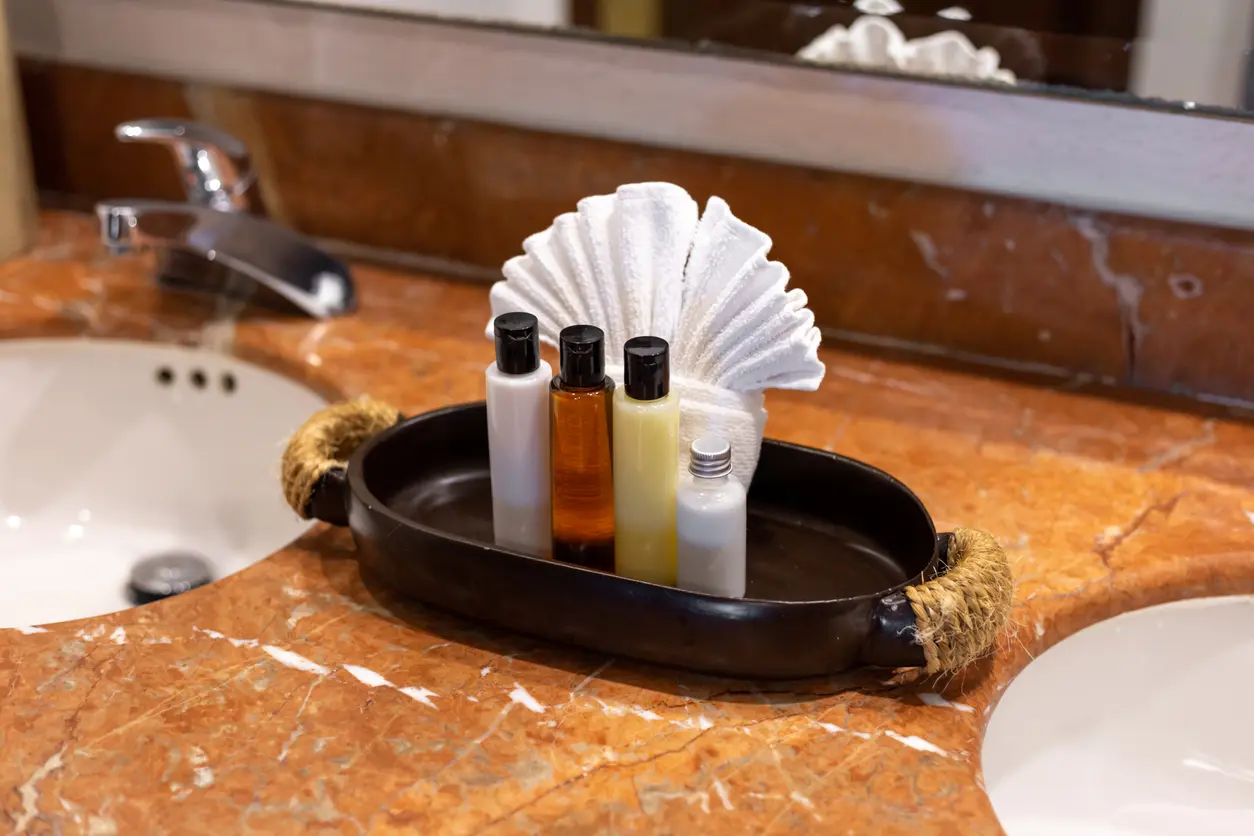
Marble communicates luxury like no other surface. Its veining creates organic, flowing patterns — from subtle wisps to bold streaks — and polished marble carries a natural luminosity that reflects light with a warmth no synthetic material replicates. This is why marble anchors the surfaces a hotel wants guests to notice. Turkey, one of the world’s great marble sources, offers the full range: Afyon White and Marmara White for bright, crisp veining, Tundra Grey for a calm contemporary field, and dramatic tones such as Milas Lilac and Elazığ Cherry where a feature wants colour. Polished marble in any of these reads, on contact, as the most refined surface in the room.
Granite’s texture and depth
Granite makes its impact through texture and depth rather than movement. Its granular, speckled surface — the visible crystals of quartz and feldspar — reads as solid, grounded and reliable, qualities that suit a space meant to feel permanent and dependable rather than ornate. Granite’s colour range runs deep and varied, and its mineral structure gives it a visual weight that anchors a surface. Where marble draws the eye with luminosity, granite holds it with substance, which is exactly the right note for a hard-working surface that still needs to look considered.
Finishes change the comparison
The finish a project picks can shift the marble-vs-granite balance, because it changes both look and performance. A honed finish takes marble’s sheen down to a soft matte that hides the fine scratches and dull etch marks traffic leaves, which is why honed marble is the right call for hotel vanities and surfaces where acidic contact is routine — it conceals the wear that polishing would showcase. Granite, already durable, takes a polished finish for reception faces, a honed matte for contemporary floors, or a flamed and brushed texture that opens up real slip resistance for entrances and wet areas. Reading finish alongside stone — honed marble where it must take wear, textured granite where it must grip — is part of specifying either one well.
Quick answer
Granite is the more durable stone for a hotel — harder at 6 to 7 on the Mohs scale against marble’s 3, less porous, and resistant to the acid etching that marks marble — so it suits high-traffic floors, countertops and bar tops. Marble leads on veining and luxury, so it belongs on feature walls, reception backdrops and protected surfaces, ideally honed where it must take wear. Most hotels use both, each where its strengths fit the zone, rather than choosing one stone for the whole property.
Living with each stone in a hotel
A stone’s behaviour over years of service, not its appearance on opening day, decides whether it was the right choice. Marble and granite ask very different things of the team that maintains them, and matching that demand to the property’s reality matters as much as matching the look.
Sealing and cleaning regimes
Both stones need sealing and pH-neutral cleaning, but the schedules differ. Marble rewards sealing every six to twelve months and tolerates only gentle, stone-safe cleaners; harsh, acidic or alkaline products etch it and strip the seal. Granite is more forgiving — sealing every year or two, and some dense granites barely need it — and it tolerates a wider range of cleaning products without harm. The detail of cleaning and sealing stone floors runs in the cleaning and sealing guide; the headline for a comparison is that granite costs less attention to keep right, while marble repays a disciplined regime and punishes a careless one.
The operational reality
The honest question with marble is not whether it is beautiful but whether a property can actually maintain it. In a hotel, a maintenance schedule that reads “seal periodically” tends to mean “whenever someone remembers,” and an under-maintained marble surface in a wet or high-acid area stains and etches quickly. Granite forgives that operational reality; marble does not. A surface used actively by guests who have no reason to be careful — a bar, a public counter, a coffee station — suits granite, while marble belongs where trained staff maintain it or where it sits protected from the worst contact. The stone has to match the housekeeping, not just the mood board.
Batch consistency across many rooms
Natural stone comes from quarry blocks that vary, so matching colour and veining across a large room count is a genuine sourcing task with both stones. Marble’s dramatic veining makes variation more visible; granite’s busy speckle can hide it or, in open coarse varieties, show it. Specifying enough material from one block run, holding matching stock for later repairs, and working with a supplier who can deliver consistent batches all protect a brand standard that subtle slab-to-slab variation would otherwise erode. This is a procurement discipline, and it applies whichever stone a project picks.
A property’s maintenance protocol, not its budget, decides whether marble belongs
Plenty of mid-scale and luxury projects can afford marble; far fewer can keep up with it. The real test of whether marble belongs on a given surface is not the budget line but the housekeeping reality — whether the property has a maintenance protocol and a trained team that will actually seal, clean and protect it on schedule. Where that protocol exists, marble rewards it with a surface nothing else matches. Where it does not, marble becomes the etched, stained surface that dates the interior faster than granite ever would. Specify marble for the surfaces a property can genuinely maintain, and put granite everywhere the operation cannot promise that care.
Where each stone belongs across a hotel
With the differences clear, the practical question is which surfaces take which stone. A hotel is a collection of very different environments, and the marble-vs-granite answer changes from one to the next.
Lobby and high-traffic floors
The busiest floors in a property — lobby, corridors, entrances — take constant grit and footfall, which points to granite’s hardness and low porosity. A dense, honed marble can carry a protected or moderate-traffic lobby where its veining is the design statement, accepting the patina it will develop. The full flooring picture sits in the stone flooring guide and the best stone for a hotel lobby floor comparison; for the two-stone choice, granite takes the busiest floors and honed marble takes the ones where the look leads and the traffic is lighter.
Feature walls, reception and cladding
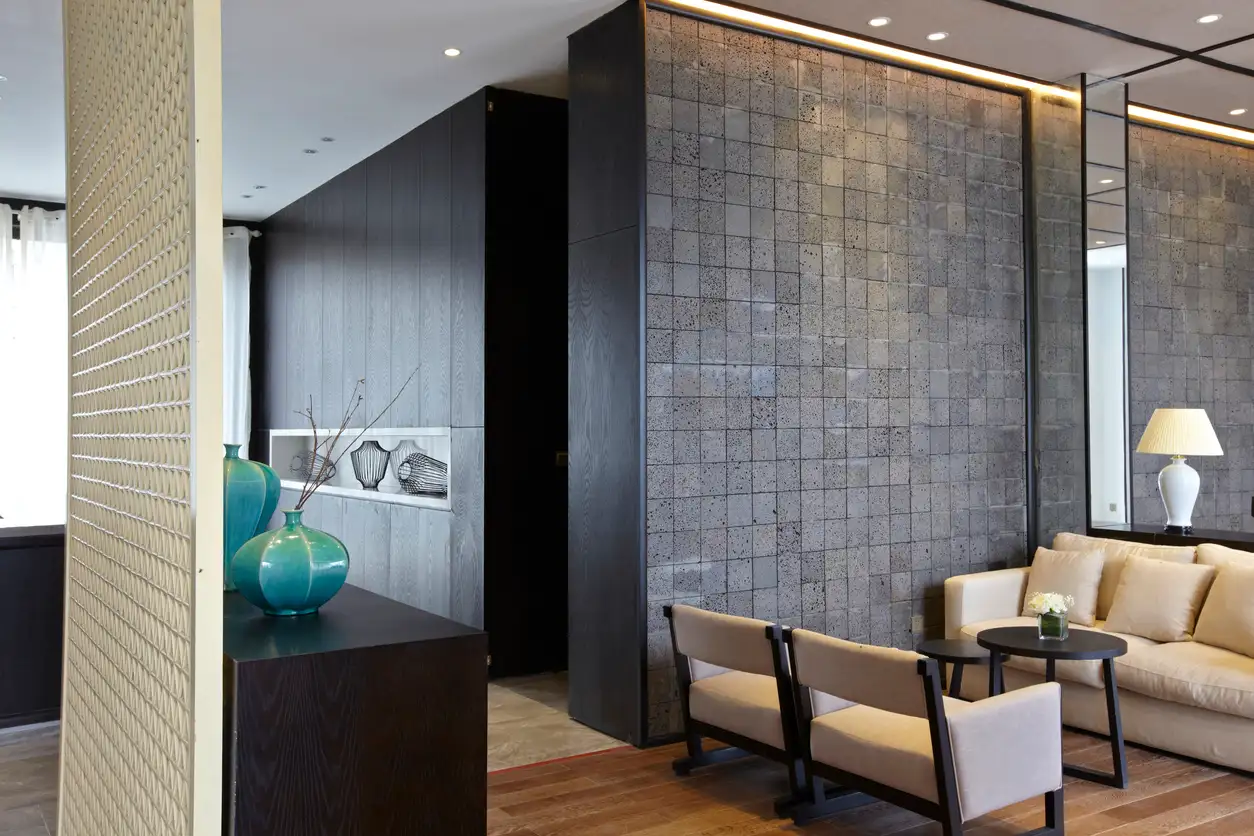
This is marble’s territory. A book-matched marble feature wall behind reception, marble cladding in a lift lobby, a marble reception desk front — these put the veining where guests see it and the stone stays protected from the worst wear. Granite plays a different role here: a granite reception or concierge surface that people use actively all day benefits from granite’s durability, where a marble one would etch under leaning, writing and spills. The detail of feature surfaces runs in the stone wall cladding guide; the principle is that marble carries the surfaces meant for admiration and granite the ones meant for hard use.
Countertops, bars and bathrooms
On working surfaces the etching difference dominates. A bar top, a coffee station or a working counter meets acids and traffic all day, which makes granite the practical champion; the full worktop comparison, including engineered options, sits in the natural stone countertops guide and the quartz vs granite vs marble countertops breakdown. In bathrooms, marble’s aesthetic often wins for vanities where the look is essential and staff maintain it, ideally honed, while granite suits surfaces that take heavier use — the stone vanity tops guide and the marble vs quartz vanities comparison carry that decision in full.
Using both together
The strongest hotel schemes rarely choose one stone for everything. They put marble where it shows and stays protected and granite where it takes the wear, coordinating the two so their tones and finishes sit well together. A marble feature wall above a granite floor, a marble vanity beside a granite shower bench, a marble reception backdrop over a granite counter — pairing the two by role gives a property both the luxury of marble and the durability of granite, each doing the job it does best.

Sourcing marble and granite for a hotel
Knowing which stone goes where is the design decision; getting both delivered, matched and on programme is the procurement one. Turkey holds around 40 percent of the world’s known natural stone reserves and leads the world in marble export, with dozens of marble types across a wide colour range, and its stone industry now produces granite alongside that marble as processing investment has grown. For a hotel, that breadth means a single Turkish source can supply both the marble features and the granite workhorses of a project.
One source for both stones
A manufacturer that runs quarry, factory and finishing under one roof gives a project consistent quality, matched batches and shorter lead times than a longer supply chain, delivered worldwide on FOB or CIF terms. Sourcing marble and granite together from one supplier also keeps the coordination simple — one relationship matching the tones and finishes across both stones, holding stock for repairs, and carrying the work from drawing to installed surface. For the full framework of selecting, finishing and sealing stone across a property, the natural stone for hotels pillar carries the detail; this guide has settled which of the two stones belongs where.
Turkey’s position as the world’s leading marble exporter rests on more than reserves. A vertically integrated supplier — quarry, factory, polishing and cutting in one chain — processes both stones into slabs, tiles and cut-to-size with the precision a hotel specification needs, and turns a processed order around in weeks rather than the months a longer European chain often takes. For a project running against a construction programme, that mix of breadth, consistency and speed keeps the stone aligned with the build, whether the order is a single feature wall or a container of matched material for a whole property.
Read marble and granite by what each does best — marble for the surfaces a hotel wants admired, granite for the ones it needs to survive use — and the two stones stop competing and start complementing. Specified that way, each holds its place in the property for decades, and the old marble-or-granite question turns into the more useful one: marble here, granite there. And sourced together from one Turkish maker, both arrive matched, finished and ready for the exact surfaces each one suits best.
Frequently Asked Questions
Is granite or marble better for hotels?
Neither is better outright — they suit different jobs. Granite is harder, less porous and resists etching, which makes it the practical choice for high-traffic floors, countertops, bar tops and reception surfaces that take active daily use. Marble is softer and more porous but carries unmatched veining and luxury, which makes it the choice for feature walls, reception backdrops and protected surfaces. Most hotels use both — marble where it is seen and protected, granite where it takes the wear.
Is marble or granite more durable for a hotel?
Granite is more durable. It sits at 6 to 7 on the Mohs hardness scale against marble’s 3, so it resists scratching far better; it absorbs very little, typically under half a percent, so it stains less; and because it is a silicate stone it does not etch from acids the way marble does. Marble is the more delicate of the two and rewards care with character, so it belongs in feature and lower-traffic positions or takes a honed finish where it must take more wear.
Why does marble etch and stain more than granite?
Marble is calcium carbonate, which reacts chemically with acids — citrus, wine, coffee, vinegar and many cleaners — and the reaction leaves a dull etch mark on the surface. Granite is made of silicate minerals that are chemically stable, so acids leave it unmarked. Marble is also more porous, so it absorbs staining liquids faster. Crucially, sealing reduces staining but does not prevent etching, so a sealed marble surface still etches from acid contact just as quickly as an unsealed one.
What is the downside of granite for a hotel?
Granite’s main downside is porosity rather than chemistry — many granites absorb oils and pigmented liquids if left unsealed, so they need periodic sealing to stay stain-resistant. Its bold, speckled look reads as grounded rather than refined, which suits some schemes more than others. And because it is a natural stone cut from different quarry blocks, matching colour and pattern across a large room count takes care at sourcing. None of these rules granite out; they are points to specify around.
Can you use marble and granite together in a hotel?
Yes, and most hotels do. The common and effective approach is to use marble where it is seen and protected — reception feature walls, lift-lobby cladding, signature vanities — and granite where the surface takes active wear, such as high-traffic floors, bar tops and working countertops. Coordinating the two so their tones and finishes sit well together gives a property both the luxury of marble and the durability of granite, each in the right place.
Which is better for hotel lobby floors, marble or granite?
For a high-traffic lobby floor, granite is the safer choice: its hardness resists the scratching that luggage wheels and grit cause, and its low porosity resists staining. A dense, honed marble can work in a protected or moderate-traffic lobby where its veining carries the design, accepting that it will develop a patina of fine scratches over time. The decision follows the footfall — granite for the busiest floors, honed marble where the look matters more and the traffic is lighter.