Quick answer
Modular hotel furniture is built from standardised, interchangeable units, seating sections, tables, staging and partitions, that connect and reconfigure into different layouts using ganging hardware, folding frames or stacking bases. Flexible furniture systems let one hotel space serve several formats and revenue streams across a single day instead of one.
A hotel that owns a ballroom, a lobby lounge or an all-day dining room is really sitting on a piece of real estate that can only be sold in one shape at a time, unless the furniture inside it can change shape too. This guide sits inside the wider question of types of hotel furniture, but it narrows down to one part of that picture: modular hotel furniture and flexible furniture systems, how they reconfigure, where they earn their keep, and how to specify them so the connectors survive years of daily handling.
Why Modular and Flexible Furniture Matters
Most hotel furniture is chosen to sit still. A guest room chair, a lobby console, a fixed banquette, these earn revenue by staying exactly where the plan puts them. Modular hotel furniture works on the opposite premise: the value of the piece comes from how easily it moves, regroups and disappears into storage when the room needs to become something else entirely.
One Room, Several Revenue Events
A property with a 400 square metre event hall that only ever hosts theatre-style conferences is leaving money on the table compared with a property that can flip the same hall from conference to banquet to standing reception inside a single working day. Each format has a different rate card, a different client and, often, a different margin. Modular seating, reconfigurable tables and mobile staging are what make that flip physically possible inside the turnaround windows an events team actually has, typically 30 to 90 minutes between bookings.
Space Efficiency Beyond the Ballroom
The same logic applies at smaller scale. A lobby that needs to host a relaxed lounge in the morning and a structured meet-and-greet in the evening benefits from modular seating that reconfigures rather than a fixed arrangement chosen for one mode only. A co-working corner that flexes between individual desks and a small group workshop needs flip-top tables and stackable chairs, not a boardroom table bolted to the floor. Flexible furniture systems turn underused square metres into bookable space more often.
The Procurement Case for Fewer, Smarter Pieces
Buying one modular system that serves five layouts is usually cheaper over a project’s life than buying five fixed furniture sets, one per format, and storing four of them unused most of the year. That storage cost is real: warehouse or back-of-house space, handling labour, and the capital tied up in furniture that sits idle. A flexible system concentrates spend into fewer, better-built pieces instead of spreading it thin across single-purpose sets.
A flexible space earns its floor more than once
Fixed furniture caps a room’s revenue at whatever one format can generate. A 400-seat theatre-style conference and a 250-cover banquet dinner in the same hall on the same day, made possible only because the seating, tables and staging reconfigure between them, is two separate revenue events on one floor plate instead of one.
Sales and events teams that quote a space by the format it can currently hold are underselling it if the furniture cannot flip fast enough to sell a second format the same day. The furniture specification, not just the floor area, decides how many times a square metre gets sold in a week.
The Core Modular and Flexible System Types
Modular and flexible hotel furniture is not one product category. It is a family of system types, each solving a different reconfiguration problem, and most event and public-area specifications combine several of them.
Modular and Sectional Seating
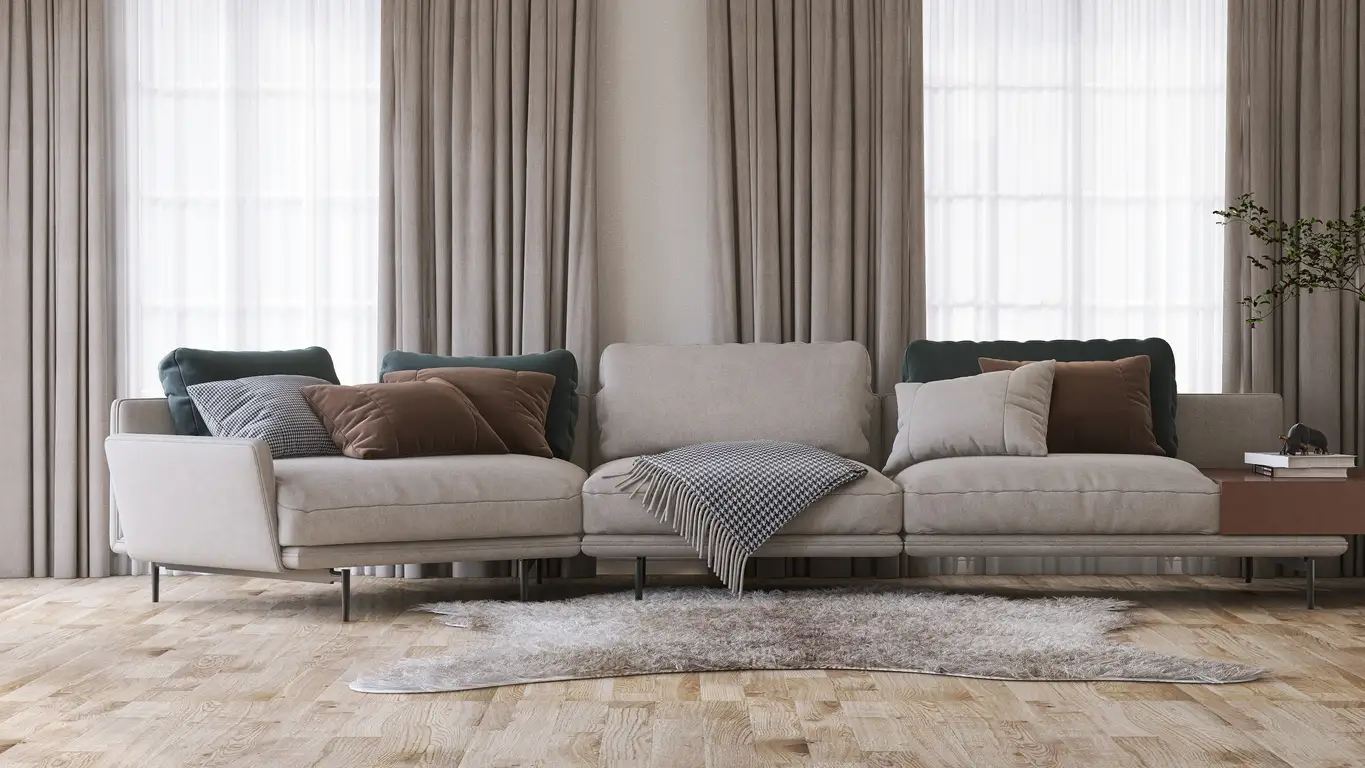
Modular sofa and lounge sections are built as individual armless, corner and end units that gang together into L-shaped, U-shaped or straight-run configurations. A lobby might run six sections as one long straight run during a conference load-in, then split the same six sections into two facing L-shapes for a lounge layout by evening. The sections share a common seat height, depth and connector spec so any unit pairs with any other, which is the entire point: a hotel is not buying six fixed sofas, it is buying one reconfigurable seating system.
Reconfigurable Banquet Tables and Staging
Banquet rooms depend on tables that switch between round, rectangular and serpentine layouts depending on whether the format is a seated dinner, a classroom-style training session or a buffet run. Mobile staging and dance-floor sections extend the same logic vertically: individual deck panels on adjustable legs that lock together into a stage of whatever footprint and height a specific event brief calls for, then break down into flat panels for trolley storage afterward.
Stackable, Folding and Nesting Furniture
Stackable and folding chairs remain the simplest and most widely used flexible furniture type in hotel event space, because they solve storage as directly as they solve reconfiguration. A stack of 8 to 10 chairs on a purpose-built dolly takes a fraction of the floor space that the same chairs would occupy set out in rows. Nesting tables and chairs, shaped so one unit slides partly under or over the next, compress storage further still for pieces that cannot fold flat. The banquet-specific detail on stacking heights, frame gauges and storage dollies sits in the dedicated guide to stackable banquet chairs.
Flip-Top and Mobile Tables on Castors
Flip-top tables hinge the tabletop vertically against the base, cutting the stored footprint of a rectangular training or banquet table by more than half. Locking castors let a full flip-top table be wheeled by one person rather than carried by two, which matters directly for turnaround speed when an events team is resetting a room against the clock. The broader question of which banquet table format suits which event type is covered in the guide to banquet furniture.
Movable Partitions and Acoustic Screens
Movable partitions and acoustic screens divide one large space into two or three smaller ones without construction, letting a ballroom split into breakout rooms for a conference and reunite into one hall for the evening’s reception. Track-mounted operable walls handle the largest spans; freestanding, castored acoustic screens handle smaller or more occasional divisions where a permanent track is not justified.
Knock-Down (KD) Casegoods
Knock-down, or flat-pack, casegoods use bolted or cam-lock joinery instead of permanently fixed joints, so a reception desk, buffet unit or lectern ships flat, assembles on site, and can be disassembled again for storage, relocation or renovation without being cut apart. This matters most for pieces that move between properties in a group or get reconfigured as a space’s brief changes over a renovation cycle. Piece-level definitions for these and other rigid furniture types sit in the guide to hotel casegoods.
| System | How it flexes | Best space | Watch-out |
|---|---|---|---|
| Modular / sectional seating | Armless, corner and end units gang into L, U or straight runs | Lobby lounges, co-working zones, pre-function areas | Connector alignment and matching upholstery batch across units |
| Reconfigurable banquet tables & staging | Round, rectangular or serpentine tops; deck panels lock into custom stage footprints | Ballrooms, multi-format event halls | Table linen sizing must match every configured shape |
| Stackable, folding & nesting | Chairs and tables stack, fold flat or nest to compress storage | Banquet halls, meeting rooms, high-turnover event space | Stack height limits and frame fatigue under daily handling |
| Flip-top / mobile tables | Tabletop hinges vertical against base; locking castors for one-person moves | Training rooms, banquet halls, multi-purpose function rooms | Castor and hinge hardware rated for daily cycling, not occasional use |
| Movable partitions & screens | Track-mounted operable walls or freestanding acoustic screens divide one space into several | Ballrooms splitting into breakout rooms, flexible F&B zones | Acoustic rating and track maintenance over years of daily operation |
| Knock-down (KD) casegoods | Bolted or cam-lock joinery assembles and disassembles without cutting | Reception desks, buffet units, multi-property or renovation-cycle furniture | Joint hardware must hold alignment through repeated assembly cycles |

Connections: Where Modular Systems Succeed or Fail
A modular system is only as reliable as the point where two units meet. The panel, the seat shell, the tabletop, these rarely fail under normal contract use. The connection between them is what wears, loosens and eventually breaks.
Ganging Clips and Alignment Pins
Ganging clips lock adjacent seating units together at the frame, stopping a sofa run from creeping apart or twisting out of line as guests sit and rise repeatedly through a day of use. Alignment pins do the quieter work of making sure two units sit flush and level with each other before the clip even engages, so a run of six sections reads as one continuous line rather than six slightly offset boxes. Cheap stamped-steel clips deform after repeated engagement; contract-grade systems use machined or cast hardware rated for thousands of connect-disconnect cycles.
Tuck-Away Links and Table Connectors
Banquet and training tables typically use tuck-away link connectors, small steel or nylon clips stored in a recess on the table edge so they never go missing between events, that pull adjacent tabletops tight and flush. A missing or worn link connector is a small hardware problem that shows up as a visible gap or wobble in a banquet table run, exactly the kind of defect a guest notices even when they cannot name what caused it.
Stacking Feet and Frame Fatigue
Stackable chairs rely on stacking feet, often nylon or reinforced polymer glides, to bear the compressive load of eight or ten chairs stacked and to protect both the frame finish and the floor beneath. A frame under-engineered for stacking load will bow or crack at the point where one chair’s feet rest inside the seat shell of the chair below it, a failure mode that is invisible until a stack collapses. Contract seating frames are load-rated for stacking, not just for a single seated occupant.
Castors and Locking Hardware
Mobile tables, staging decks and partition screens depend on castors that lock reliably under load and release just as reliably when a section needs to move again. A castor that seizes after months of daily use turns a flip-top table from a one-person move into a two-person struggle, quietly adding labour cost to every reset an events team performs.
In modular furniture, the connection is the weak point, not the panel
A tabletop or a seat panel built to contract spec rarely fails on its own. What fails first, almost without exception, is the hardware at the joint: a ganging clip that has been engaged and disengaged a thousand times, a castor bearing that has carried a loaded staging deck across an uneven service corridor, a stacking foot that has taken the compressive weight of a nine-chair stack every night for two years.
Specifying a modular system on panel quality alone and treating the connector hardware as an afterthought is the single most common mistake in flexible furniture procurement. Ask a supplier for the connector’s cycle rating and load rating before asking about finish options.
Where Hotels Deploy Flexible Furniture Systems
Modular and flexible furniture earns its place wherever a hotel space has more than one commercial use across a week, which in most properties is more spaces than owners initially assume.
Ballrooms and Multi-Purpose Event Halls
This is the highest-stakes application: a ballroom that flips between conference, banquet, exhibition and reception formats needs modular seating, reconfigurable tables, mobile staging and movable partitions working together as one coordinated system, not as separate purchases from different suppliers with incompatible connectors.
Lobby and Pre-Function Areas
Lobbies increasingly need to serve as arrival space, casual meeting space and overflow pre-function space for adjacent events, sometimes within the same afternoon. Modular sectional seating that regroups from a relaxed lounge configuration into rows or clusters supporting an event handles that shift without a full furniture change-out.
Business Centres and Co-Working Corners
A hotel’s co-working or business-centre area benefits from flip-top tables and stackable chairs that convert between individual work desks and a small meeting or workshop layout, giving one modestly sized space two distinct commercial identities depending on demand that day.
F&B Spaces That Shift Formats
A restaurant that runs breakfast buffet service, all-day dining and private dinner bookings needs table configurations that change between those formats without a full reset each time, using tables that regroup from twos into larger runs and movable screens that section off a private dining area on demand.
| Typical turnaround | 30–90 min | Time an events team has to flip a hall between bookings |
|---|---|---|
| Chair stack height | 8–10 high | Common contract-grade stacking limit before stability drops |
| Connector cycles | 1,000s rated | Contract-grade ganging hardware, not residential fittings |
The Loose-Furniture Connection
Almost everything covered here is loose rather than fixed furniture, by definition: a piece has to be movable to be reconfigurable. The fuller distinction between what stays put and what moves, and why that split matters for procurement and depreciation, sits in the guide to loose furniture vs fixed furniture.
A room’s furniture spec decides how many businesses that room can run. Fixed furniture picks one. Flexible furniture leaves the choice open every day.
Modular vs Multifunctional: Not the Same Thing
These two terms get used interchangeably in casual conversation, and that habit causes real confusion at RFQ stage, because they describe different design strategies solving different problems.
Modular Means a System of Interchangeable Units
Modular furniture is a set of separate, standardised pieces that combine in different arrangements to serve different layouts across a space, usually a public or event area. The unit of design is the system: six sofa sections, twelve banquet tables, forty stacking chairs, all built to a shared connector standard so they regroup on demand.
Multifunctional Means One Piece Doing Two Jobs
Multifunctional furniture is a single piece engineered to perform two roles at once, most often to save floor area in a fixed spot rather than to reconfigure a whole room. A guest room bed with integrated under-bed storage, an ottoman that opens into extra luggage space, a desk that folds down from the wall, these are multifunctional: one object, two jobs, one location. This is a distinct guest-room design problem from the systems-level reconfiguration covered in this guide, and it is treated in full in the separate guide to multifunctional and space-saving furniture.
Where the Two Overlap, and Where They Do Not
A folding banquet table is arguably both: it is one piece doing two things (tabletop, flat storage panel) and it is also part of a larger modular system (a run of identical tables that reconfigure together). Most guest room multifunctional furniture, by contrast, is not modular at all, because it is not designed to connect with or regroup alongside other units. Knowing which problem a specifier is actually solving, room-level space saving or hall-level reconfiguration, decides which category of furniture and which supplier conversation is the right one.
Why the Distinction Matters at Brief Stage
A design brief that asks for “flexible furniture” without specifying whether the goal is systems-level reconfiguration or single-piece space efficiency risks a mismatched quote: a supplier pricing modular banquet systems when the actual need was compact guest room casegoods, or vice versa. Naming the correct category early keeps the RFQ, and the resulting furniture, matched to the actual operational problem.

Specifying Modular Systems Contract-Grade
Getting a flexible furniture system onto a floor plan is the easy part. Making sure it survives years of daily reconfiguration under contract use takes a more deliberate specification.
Load and Cycle Ratings, Not Just Finish
A modular furniture RFQ should ask for connector cycle ratings, stacking load limits and castor duty ratings alongside the usual finish and fabric questions. A supplier who cannot answer how many connect-disconnect cycles a ganging clip is rated for, or how many chairs a stacking foot is engineered to carry, has likely not tested the system for contract-grade daily reconfiguration.
Matching Dimensions Across the Whole System
Every unit in a modular run needs to share the same seat height, table height and connector geometry, or the system stops reading as one continuous piece of furniture the moment two mismatched units sit side by side. The metric dimension bands that govern this consistency, seat height, table height, standard module widths, are covered in the guide to hotel furniture dimensions, and apply just as strictly to a modular system as to a single fixed piece.
Storage Planning as Part of the Specification
A flexible furniture system is only as fast as the storage plan behind it. Stack heights, trolley dimensions, back-of-house corridor widths and lift access all need to be checked against the actual pieces being specified, not assumed to work because the chairs technically stack. A system that stacks eight-high on the showroom floor but only fits six-high through the service lift is a system that will not hit its turnaround targets on site.
Cross-Checking Against the Full Furniture Schedule
Modular and flexible pieces need to be tracked on the same master schedule as every other item in the building, not managed as a separate, informal list by the events team. Cross-referencing against the property’s complete hotel furniture list at planning stage catches gaps, such as a partition system specified without the acoustic screens it depends on, before production starts rather than after delivery.
Procurement and Delivery Sequencing
Modular systems often ship in stages, base frames first, then connector hardware, then finish components, and a sequencing error at delivery can leave a hall with tables but no link connectors, or chairs but no storage dollies. Coordinating this sequencing is part of the same furniture procurement process that governs the rest of a project’s FF&E, and should not be treated as a separate, lower-priority delivery stream.
Working With One Supplier Across the System
Sourcing seating from one manufacturer, tables from another and staging from a third is the most common cause of connector mismatch: three suppliers’ hardware standards rarely align, even when every individual piece meets spec on its own. A single manufacturer building the seating, tables, staging and partitions to one shared connector and dimension standard removes that risk before it reaches the loading dock.
Frequently Asked Questions
What is modular hotel furniture?
Modular hotel furniture is built from standardised, interchangeable units that connect through ganging clips, alignment pins or tuck-away links to form different layouts. A hotel reconfigures the same seating, tables or staging pieces into new arrangements without buying separate furniture for each event.
What are the benefits of modular and flexible furniture for hotels?
Modular and flexible furniture lets one room serve conference, banquet and reception layouts in the same day, raising revenue per square metre. It also cuts storage footprint through stacking and nesting, and reduces total furniture spend versus buying fixed sets for every format.
Where do hotels use modular and flexible furniture?
Ballrooms and event halls, lobby lounges, co-working and business-centre areas, and F&B spaces that shift between breakfast, all-day dining and private events all rely on modular and flexible furniture systems to change format quickly and reliably.
What is the difference between modular and multifunctional furniture?
Modular furniture is a system of separate interchangeable units that combine into different layouts across a space. Multifunctional furniture is a single piece designed to do two jobs, such as a bed with built-in storage, usually to save space in one fixed spot.
Are modular furniture systems durable enough for contract use?
Yes, when specified to contract grade. The connectors, hinges and edges take repeated handling, so frames, ganging hardware and stacking feet need commercial-duty ratings and testing, not residential-grade fittings that loosen or crack under constant reconfiguration.
Is modular furniture worth the investment for a hotel?
For any space that changes format regularly, yes. The higher per-unit cost of contract-grade modular systems is offset by fewer furniture purchases overall, lower storage and labour costs, and additional bookable events the same floor area can now hold.