In short
There is no single best material. A cabinet is two decisions — the carcass board and the door surface. Plywood or moisture-resistant board for the box, MDF or solid wood for the doors, and laminate, melamine or veneer for the surface, each chosen for its job.
The kitchen cabinet material decides almost everything that follows — how long the cabinets last, how they handle moisture, how they look and what they cost — so it is the first real decision in any kitchen specification. For a single home that choice answers to taste and budget; for the hotel, aparthotel and project kitchens we build in our contract kitchen cabinet workshop, the material has to survive heavy guest use, repeat to one standard across a building, and hold up around water and heat for a full refurbishment cycle. This guide compares the main kitchen cabinet materials — solid wood, plywood, MDF, particleboard, laminate, melamine and veneer — and sets out which to specify for which job, from the maker’s side.
There is no single best kitchen cabinet material, because a cabinet is really two material decisions: the board that forms the carcass and doors, and the surface that faces them. Get both right for the use and the kitchen lasts; get either wrong and it fails early, usually at the sink. The sections below work through the boards, then the surfaces, then durability, moisture and the high-end question, and close on sourcing contract-grade material for a project.
Choosing the Right Kitchen Cabinet Material
Choosing a kitchen cabinet material means weighing four things at once: durability, moisture resistance, finish quality and cost. No material wins on all four, so the right choice balances them for the specific job — and in a contract kitchen, durability and moisture resistance lead, because the cabinets take harder use than any home kitchen ever sees.
Carcass and Door: Two Different Material Decisions
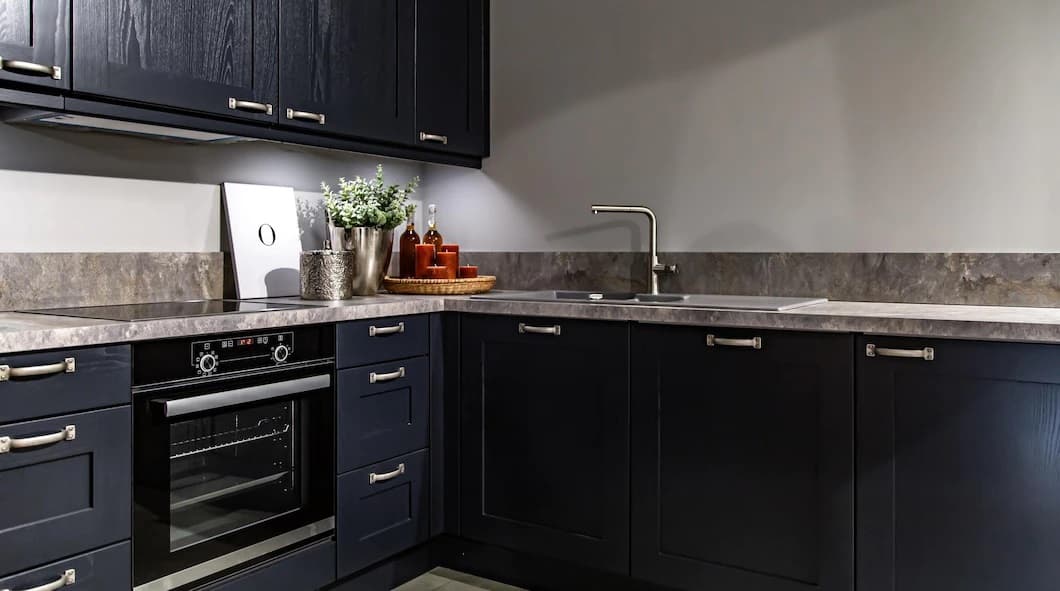
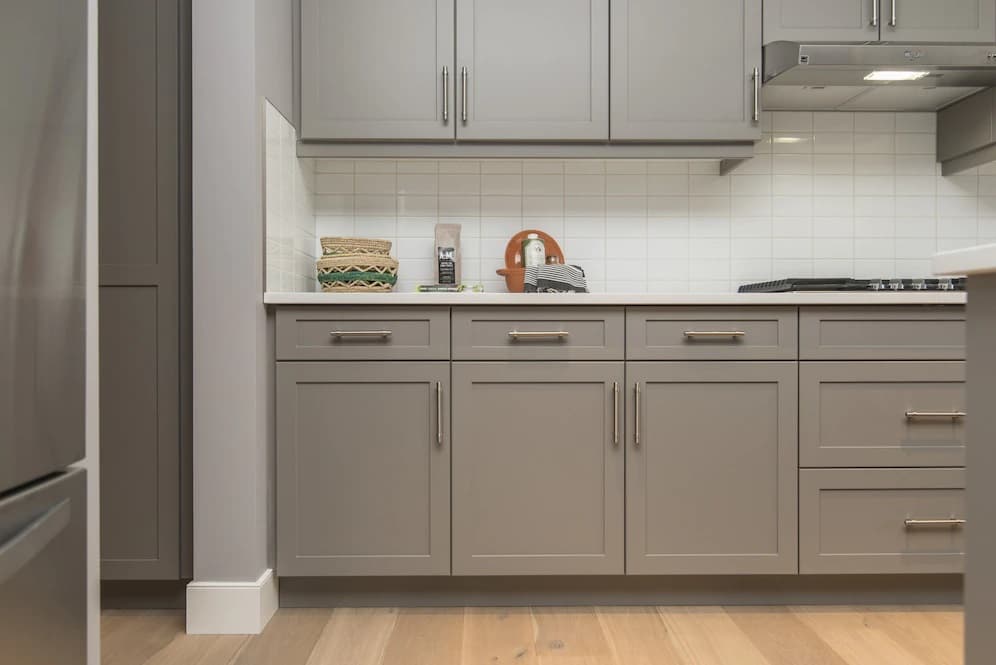
The single idea that clears up most confusion is that a cabinet uses different materials in different places. The carcass — the structural box — needs strength, screw-holding and moisture resistance, which points to plywood or a moisture-resistant board. The doors and fronts are the visible, hard-wearing layer, which points to a board that takes a good finish, such as MDF for paint or lacquer. Treating the carcass and the doors as separate material decisions, rather than choosing one material for the whole cabinet, is exactly how a maker specifies a good kitchen. A common contract build pairs a plywood or moisture-resistant carcass with MDF doors faced in laminate or lacquer.
How to Judge a Material
Four tests sort the materials quickly. Durability asks how the board holds up to years of daily use without sagging, chipping or failing at the joints. Moisture resistance asks how it behaves near sinks, dishwashers and steam, where ordinary boards swell. Finish quality asks what surface the board accepts — a smooth paint, a laminate, a veneer. Cost asks what the board adds per unit across a whole project. Score any material against those four and its right place in the kitchen becomes clear, which is the logic the scorecard below follows.
Quick answer
What is the best material for kitchen cabinets? There is no single best material; a good kitchen pairs the right board with the right surface for the job. Plywood is the strongest, most moisture-tolerant carcass board; solid wood is the premium choice for doors where budget allows; MDF is the best board for a smooth painted or lacquered door; and high-pressure laminate or melamine over a stable board gives a hard-wearing, easy-clean surface for high-use kitchens. For a contract kitchen, a plywood or moisture-resistant carcass with MDF or laminate-faced doors is the durable default.
The Core Boards Compared
Four boards make up almost every kitchen carcass and door, and each has a clear place. Knowing what each does well — and where it fails — lets a specification put the right board in the right part of the cabinet.
Solid Wood
Solid wood is the premium, classic kitchen cabinet material, prized for natural beauty, strength and longevity. A well-made solid-wood cabinet lasts decades, accepts refinishing or repainting over its life, and brings a warmth no engineered board matches, which suits villa and premium suite kitchens. The trade-offs are real: solid wood costs more than any other material, weighs more, and can warp or move with humidity if it is not kiln-dried and properly sealed. Choosing kiln-dried hardwood and sealing it well manages that risk. For doors and visible timber where budget allows, solid wood remains the benchmark; for whole carcasses at scale, its cost and movement usually rule it out.
Plywood
Plywood is the strongest practical board for a kitchen carcass, made by gluing thin wood layers with their grain crossed, which gives it excellent strength, screw-holding and resistance to moisture and movement. It outperforms MDF and particleboard for a carcass that has to carry worktops, hold hinges and runners firmly, and survive damp, which is why serious kitchens use it for the box. Plywood costs more than MDF or particleboard and needs a veneer or laminate to finish, and its edges can show voids if the grade is low. Specifying a high grade keeps those edges clean. For a contract carcass in a demanding, moisture-prone kitchen, plywood is the safest board there is.
MDF
MDF — medium-density fibreboard — is the smoothest, most stable board for doors, made from fine wood fibres bonded under heat and pressure. Its dense, even surface takes paint and lacquer beautifully with no grain to telegraph through, which makes it the default for painted and lacquered contract doors, and it resists the cracking and warping that can affect solid wood. MDF is less strong than plywood, holds screws less well, and swells if water reaches an unsealed edge, so it suits doors and panels more than a structural carcass. Moisture-resistant MDF handles damp areas far better than the standard grade. For a smooth, colour-matched door at a sensible cost, MDF is hard to beat.
Particleboard
Particleboard — chipboard — is the most affordable kitchen cabinet material, made from wood chips bonded with resin, and it is the board that fills most flat-pack and ready-to-assemble kitchens. Its appeal is purely cost: it is cheap and light. Its weaknesses are serious for a kitchen — standard particleboard is not moisture-resistant and swells when water reaches it, it holds screws poorly, and it is hard to repair once damaged. In contract work it appears only in a high-density, moisture-resistant, fully laminated grade with sealed edges, never the basic version, and even then it sits in lower-stress, dry locations. Where you see a kitchen quoted suspiciously cheap, the board is almost always basic particleboard.
The scorecard below rates the boards and surface materials at a glance, before the table sets out their best uses.
| Material | Role | Durability | Moisture | Best contract use |
|---|---|---|---|---|
| Solid wood | Door / timber | Excellent — decades | Fair — needs sealing | Premium suite & villa doors |
| Plywood | Carcass / box | Excellent — strong | Good — tolerates damp | Carcasses, wet-run boxes |
| MDF | Door / panel | Good — stable | Fair — MR grade better | Painted & lacquered doors |
| Particleboard (MR) | Carcass (budget) | Fair — laminated only | Poor–fair — sealed only | Low-stress, dry, volume units |
| HPL laminate | Surface finish | Very good — tough | Good — wipe-clean | High-turnover, easy-clean fronts |
| Melamine | Surface finish | Good — grade-dependent | Fair–good | Budget & back-of-house fronts |
| Veneer | Surface finish | Good — real wood | Fair — needs sealing | Premium natural-look doors |
The professional build: plywood box, MDF door — not one material throughout
Buyers often ask which single material a kitchen should be made of, but a well-specified kitchen rarely uses just one. The durable, professional build pairs a plywood or moisture-resistant carcass — for strength, screw-holding and damp resistance where it matters — with MDF doors that take a flawless painted or lacquered finish, faced in laminate where easy cleaning leads. That combination puts each material where it performs best and controls cost, rather than over-spending on solid wood everywhere or under-building the whole kitchen in particleboard. When you read a kitchen specification, look for this split; a single cheap board used throughout is the clearest sign of a kitchen built to a price rather than a standard.
Surface Materials: Laminate, Melamine and Veneer
The board is only half the cabinet; the surface that faces it sets the look and much of the durability. Laminate, melamine and veneer are the main surface materials, each bonded over a board rather than used alone, and each suits a different brief. The finish itself — how a surface goes on, the colour and the lacquer options — is its own subject; here the focus is the surface material and how it performs.
Laminate and High-Pressure Laminate
Laminate is a thin, decorative surface bonded over MDF or particleboard, and high-pressure laminate (HPL) is its toughest form. HPL resists stains, scratches, heat and moisture, cleans with a wipe, and comes in a huge range of colours and textures, which makes it the workhorse surface for high-turnover hospitality kitchens. It is affordable, durable and low-maintenance, and a good HPL door survives heavy guest use where a painted finish would chip. The limits: a low-quality laminate can look artificial, and a poorly bonded edge can peel over time, which is why edge banding and bonding quality matter as much as the laminate itself. For an aparthotel or busy hotel kitchen, HPL over a stable board is often the smartest surface.
Melamine
Melamine is a resin-saturated surface fused directly onto a board, most often particleboard or MDF, giving a hard, smooth, easy-clean face at a low cost. It resists moisture and stains reasonably well, comes in many colours and wood looks, and suits budget-conscious projects and back-of-house kitchens where function leads. Its weaknesses are that lower grades can chip at the edges and the look can read as flat next to HPL or real veneer. The question of melamine versus MDF confuses many buyers, but they are not alternatives: melamine is a surface, MDF is a board, and a melamine-faced MDF panel uses both. Specified in a quality grade with sealed edges, melamine is a sound, economical surface; in a cheap grade it is the first thing to chip.
Veneer and Thermofoil
Veneer is a thin layer of real wood bonded over a stable board such as MDF or plywood, giving genuine wood grain and warmth at a fraction of the cost and weight of solid timber. It suits premium suite and villa kitchens that want a natural look without solid-wood movement, and it takes stain or finish like real wood — which it is. Thermofoil, a vinyl heat-sealed over MDF, offers a seamless, easy-clean alternative in solid colours, though it can struggle near high heat. Veneer reads as the most premium surface short of solid wood, while thermofoil sits at the practical, lower-cost end. Both depend entirely on the board beneath and the quality of the bond.
Durability, Moisture and the High-End Question
Three questions decide most material choices in practice: which materials actually last, how each handles the water a kitchen throws at it, and what the high-end kitchens are really made of. The answers cut through a lot of marketing.
Which Materials Last
For pure durability, solid wood and plywood lead, both able to carry a kitchen for decades with care. MDF and quality laminate sit in a strong middle, durable for doors and surfaces though less suited to structural loads. Basic particleboard sits at the bottom, the material most likely to sag, swell or fail under real use. The single biggest durability factor, though, is not the headline material but the construction around it — sealed edges, quality hardware and a moisture-resistant grade turn a mid-tier board into a long-lasting cabinet, while poor construction lets even a good board fail early.
Moisture and Waterproofing
A kitchen is the wettest room a project fits out, so moisture resistance often matters more than raw strength. No common cabinet board is truly waterproof, but they differ hugely in how they cope: plywood and moisture-resistant MDF tolerate damp well, melamine and HPL surfaces shrug off splashes, and standard particleboard fails fastest. The wet run — the cabinets around the sink and dishwasher — settles this, and it needs a moisture-resistant board with fully sealed edges as a baseline, whatever the rest of the kitchen uses. Specifying a moisture-resistant grade and sealed edges on the wet run is the closest a real kitchen gets to waterproof.
What High-End Cabinets Are Made Of
The question of what high-end cabinets are made of has a clear answer: solid wood and high-grade plywood, with real veneer surfaces and premium hardware. The most expensive material is solid hardwood, and the best-quality cabinets combine a plywood carcass, solid-wood or veneer doors, and the construction details — dovetailed drawers, sealed edges, soft-close commercial hardware — that separate the three rough grades of cabinet: stock, semi-custom and custom. High quality shows less in a single luxury material than in the whole build: the board grades, the joinery and the hardware together. A cabinet can look high-end on the door and sit on basic particleboard behind, which is why the carcass spec tells the real story.
How to tell MDF from particleboard — and why the IKEA question matters
Buyers often ask whether flat-pack kitchens are MDF or particleboard, and how to tell them apart. The quick test: MDF has a smooth, dense, uniform edge with no visible chips, feels heavier, and takes a clean painted edge; particleboard shows coarse chips and flakes at a cut edge, feels lighter, and never paints cleanly. Most flat-pack kitchens, including the volume ranges, use particleboard for the carcass with a melamine or foil face, and MDF only for some doors. For a contract buyer the lesson is to ask exactly which board sits where — carcass and doors separately — because a kitchen described loosely as “wood” or “engineered” can be anything from plywood to basic chipboard, and the difference decides how long it lasts.
Matching Material to the Project
The right material is the one that fits the job, the budget and the kitchen type. Matching the specification to the project — rather than defaulting to the cheapest board or the most expensive — is what gives each kitchen its right build.
By Durability and Budget
Most projects balance durability against budget, and the boards map onto that neatly. For maximum durability, a plywood carcass with solid-wood or veneer doors leads; for the best value, MDF doors and a moisture-resistant carcass faced in laminate deliver durability without the solid-wood premium; for the tightest budgets, a high-density, moisture-resistant, laminated particleboard can work in lower-stress areas, though never on the wet run. The trap is buying on headline price alone, because a cheap board that fails in two years costs far more than a sound one that lasts the cycle. Spend where durability matters — the carcass, the wet run, the hardware — and economise where it does not.
By Kitchen Type
Different kitchens in a property call for different materials. A premium suite or villa kitchen justifies solid-wood or veneer doors over a plywood carcass for the look and longevity guests expect. An aparthotel or compact kitchen, used hard and reset between guests, leans on durable, easy-clean HPL-faced doors over a moisture-resistant board, where wipe-clean durability matters more than a luxury finish. A staff kitchen or back-of-house pantry asks for pure durability — moisture-resistant board and laminate, looks a secondary concern. Specifying the material by kitchen type, within one project standard, gives each space the right build without over- or under-spending.
Materials to Avoid and What Dates
A few choices reliably disappoint. Basic, non-moisture-resistant particleboard anywhere near water is the clearest material to avoid in a kitchen, as is any cheap laminate or melamine with thin, poorly bonded edges that peel. Beyond durability, very high-gloss or strongly trend-led surfaces date fastest and show every mark, which works against a kitchen meant to last a cycle. The materials that age slowly are the quiet, durable ones — quality wood, veneer, matt or satin laminate — in restrained finishes. For a project, choosing materials that resist both moisture and fashion is what keeps a kitchen sound and current across its life.
Sourcing Contract-Grade Materials
With the boards and surfaces understood, sourcing turns the material decision into installed kitchens. For a project, the grade of material and the maker behind it matter as much as the material name, because the same board exists in domestic and contract grades that perform very differently.
Contract-Grade vs Domestic Boards
The same material name covers a wide quality range, and contract grade is where durability lives. A contract-grade plywood, moisture-resistant MDF or high-pressure laminate is denser, better bonded and more moisture-tolerant than the domestic version sold for flat-pack kitchens, and it carries the fire and emission certification public buildings require. Specifying contract grade — not just the material name — is what separates a kitchen that survives commercial use from one that looks similar on day one and fails within a couple of years. On a quote, the grade, certification and edge specification matter as much as the headline board.
Specifying Material with a Manufacturer
A contract manufacturer specifies material by part: the carcass board, the door board, the surface, the edge and the hardware, each chosen for its job and certified to the project’s standards. As a workshop we produce contract kitchen cabinets in MDF, plywood, laminate, lacquer and wood — pairing a durable, moisture-resistant carcass with the door and surface a project calls for — custom to your drawings and brand, for hotels, aparthotels, villas and projects, on FOB or CIF terms with a four-to-eight-week lead time and a two-year warranty, delivered worldwide. For the full specification picture, our contract kitchen cabinet guide covers doors, layouts and sourcing, and the kitchen cabinet measurements guide covers sizing the units the material builds.
Choosing the right kitchen cabinet material comes down to a clear method: treat the carcass and the doors as separate decisions, put plywood or a moisture-resistant board where strength and damp matter, use MDF or solid wood for the doors and the right surface over them, specify contract grade with sealed edges on the wet run, and match the build to each kitchen type within one project standard. Do that and a property’s kitchens hold up across the refurbishment cycle, room after room; default to the cheapest board and the same weakness repeats everywhere. Specify the material part by part, properly, and the kitchen lasts.
Frequently Asked Questions
What is the best material for kitchen cabinets?
There is no single best material; a good kitchen pairs the right board with the right surface. Plywood is the strongest, most moisture-tolerant carcass board; solid wood is the premium door choice where budget allows; MDF is the best board for a smooth painted or lacquered door; and HPL laminate or melamine over a stable board gives a hard-wearing, easy-clean surface. For a contract kitchen, a plywood or moisture-resistant carcass with MDF or laminate-faced doors is the durable default.
Which kitchen cabinet material is most durable?
Solid wood and high-grade plywood are the most durable, both able to carry a kitchen for decades. MDF and quality laminate sit in a strong middle for doors and surfaces, while basic particleboard is the least durable and most likely to swell or sag. The biggest durability factor, though, is construction: sealed edges, moisture-resistant grade and quality hardware turn a mid-tier board into a long-lasting cabinet.
Is MDF or melamine better for kitchen cabinets?
They are not really alternatives, because MDF is a board and melamine is a surface fused onto a board. A melamine-faced MDF panel uses both. MDF on its own takes a superior painted or lacquered finish; melamine gives a hard, easy-clean, low-cost face in many colours. For a smooth designed finish, choose MDF with paint or lacquer; for a tough, economical, wipe-clean surface, choose a quality melamine or laminate over MDF.
What are high-end kitchen cabinets made of?
High-end cabinets use solid wood and high-grade plywood, with real veneer surfaces and premium hardware. The most expensive material is solid hardwood, but quality shows in the whole build, not one material: a plywood carcass, solid-wood or veneer doors, dovetailed drawers, sealed edges and soft-close commercial hardware. A cabinet can look high-end on the door yet sit on basic particleboard behind, so the carcass specification tells the real story.
How can you tell if cabinets are MDF or particleboard?
Look at a cut edge. MDF has a smooth, dense, uniform edge with no visible chips, feels heavier, and takes a clean painted edge. Particleboard shows coarse chips and flakes at the edge, feels lighter, and never paints cleanly. Most flat-pack kitchens use particleboard for the carcass with a melamine or foil face, and MDF only for some doors, so it is worth asking exactly which board sits in the carcass and which in the doors.
What is the most moisture-resistant kitchen cabinet material?
No common cabinet board is fully waterproof, but they differ widely. Plywood and moisture-resistant MDF tolerate damp best among boards, while melamine and HPL surfaces shrug off splashes; standard particleboard fails fastest. The wet run around the sink and dishwasher needs a moisture-resistant board with fully sealed edges as a baseline. A moisture-resistant grade plus sealed edges is the closest a real kitchen gets to waterproof.